Uncompromising Ideals
[ Follow Ups ] [ Post Followup ] [ The Judgment of Paris ] [ FAQ ]
Posted by HSG on April 20, 2005 at 19:50:51:
(The joyous news coming out of Italy yesterday, and the far less encouraging media discussions that have resulted, reminded this author of a little item that he wrote privately, for a good friend, in January 2003. Some of the ideas in this write-up have appeared on this forum in subsequent posts, but the original essay could have its own interest, as well.) During our interview with stylist Samantha Weston, we were intrigued by her use of a certain word to describe the appeal of plus-size beauty. Taboo. The idea seemed congruent with other phrases that have been used to characterize the allure of womanly proportions, such as "dangerous beauty," "dangerous curves," "forbidden femininity," and so forth. Those are all such captivating words, aren't they? Taboo. Dangerous. Forbidden. They carry with them an exciting notion of . . . transgression. But are they accurate? Are full, feminine curves really so threatening? When you stop to think about it, it's amazing the lengths to which we, as a society, will go, to keep full, feminine figures under wraps: -We camouflage them with floor-length tent-dresses, or with boxy suits. But why? What makes those generous contours so intimidating? Before we try to answer that, we must remember that this effort to conceal womanly curves represents a radical break from the practices of any era in Western history. From the origins of Classical civilization, right down through the nineteenth century, women with the body type that we now find so troubling were considered the ideal of feminine beauty. So why do we now suppress the opulent contours that once represented the height of human perfection? What else did we, as a society, try to remove, and hide in basements, and conceal from public view? Whereas two hundred years ago, a German philosopher could assert that "the basic characteristic of every work of art is beauty," a mere glance at the cultural artifacts of the last half-century reveals that the basic characteristic of contemporary art is its complete lack of beauty. Therefore, beauty must be the answer. Beauty is the dangerous element that our culture has hidden away from the public eye. The ideal of Classical feminine beauty has been suppressed because beauty itself has been suppressed. Curves are dangerous, because beauty is dangerous The attempt to minimize the visibility of feminine curves is merely part of a greater societal effect to restrict all manifestations of ideal beauty. Therefore, whatever makes feminine curves so dangerous must be the same thing that makes beauty itself so threatening. The poem that we lighted on was an old chestnut by John Keats, titled "Ode on a Grecian Urn"--a meditation on the significance of a three-thousand-year-old Greek vase. Some of you may remember this poem from your high-school days. You may recall studying it, but not really understanding it. However, one line in particular may have impressed itself on your minds: "Beauty is Truth, Truth Beauty." It seems like an agreeable concept, doesn't it? It almost sounds like a platitude, like the Golden Rule, or a bit of folk wisdom. But on this particular evening, as we were reading this poem with the question of beauty's banishment still nagging at us, that statement suddenly stood out, and its greater significance became apparent. After all, what is "Truth"? Are we not told, time and again, that there is no such thing as truth--only shifting perspectives, only answers that are "technically accurate"? And what about beauty? Isn't beauty "in the eye of the beholder"? Isn't it all subjective? All relative? Isn't that what we have been taught to believe? And it isn't hard to understand why so many individuals accept this modern evaluation. Beauty and truth may sound nice enough on the surface, but on some level, people are intuitively aware that these notions have an intimidating severity about them. They are rigid and unbending, allowing for no possibility of compromise. You are going to die--truth. Some of us are born without beauty, and will never possess it--even with all of the plastic surgery that money can buy. Some of us will never be able to create beauty, no matter how hard we endeavour to do so. We may never be able to write beautifully, or paint a stirring picture, or dance in a rhythmic way--no matter how much we wish that we could. We may try to deceive ourselves that we can. Well-meaning loved ones might encourage us with false flattery. But that nagging voice of artistic conscience at the back of our minds eventually breaks the bad news to us. We can't. We may even hate them for that very reason. We may hate the truth because it is painful. "The truth hurts," as the old saying goes--and it certainly does. And as for beauty, we may hate it just as much, because it shames us, or it inspires feelings of jealousy in us, or possessiveness, or inadequacy. Isn't it better to do away with higher aspirations altogether, and live an unreflective, lobotomized existence, cushioned by cultural Prozac? And is that the kind of thinking that led to the prohibition of intoxicating, feminine curves? Have we replaced voluptuous allure with the modest charms of skinniness for our own . . . protection? Have we become aesthetic teetotalers out of a levelling impulse? And isn't our world better for it? Isn't it easier to live in a world where beauty has been expelled, and where truth and lie are relatively the same thing? No, it is not. It is not easier to live in such a world at all. And that's why beauty is coming back. It's coming back because we need it. Because Beauty and Truth--those granite-like ideals, those windswept pinnacles where the water is scare, but where the air is clear--are capable of saving our lives, when nothing else can. But beauty lives on. Even after plagues and famines, even after acts of the most appalling human barbarism, and the cruellest twists of Fate, even after tragedies both personal and cosmic, Beauty still endures. And a nameless compulsion prompted him to take a chisel in hand, approach a block of marble--a stone so unyielding, but so lasting, like the Ideal itself--and hew that implacable block into the image of beauty that he found his heart, to make that source of solace real, in the form of an impossibly lovely goddess. When old age shall this generation waste, The poet who wrote those lines was a sad, destitute, brilliant young man, who died tragically at the age of 24. But in the midst of his troubled life, this gorgeous work of Grecian art inspired him, roused him from his limited existence, stirred his higher faculties, and gave him a moment of lasting joy. And Keats realized that it would perform the same magic for people born two centuries after him, as it had for people born two millennia before him--people with problems very different from his own, but with the same intensity of heartache, and longing. He knew that "In midst of other woe / Than ours," this work of beauty would remain forever the same--imperishable, undiluted, uncompromised, and pure. Kati Kochanski in the pure white of ideality, from Alfred Angelo: 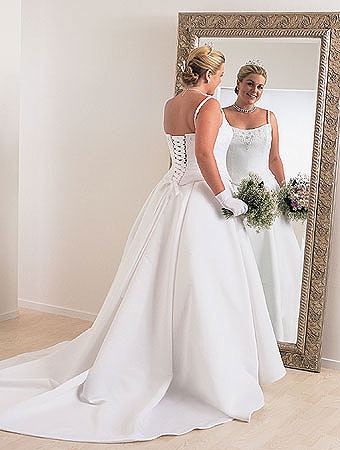
|
