''Romantically dark''
[ Follow Ups ] [ Post Followup ] [ The Judgment of Paris ] [ FAQ ]
Posted by HSG on May 19, 2005 at 04:27:16:
In Reply to: ''Midnight Rendezvous'' posted by Emily on May 18, 2005 at 21:14:24:
"Romantically dark." What a wonderful phrase. Torrid has always possessed an artistic side, and it's wonderful to see it exhibited in this cover. Romantic darkness is a natural compliment to the bright, springtime beauty for which Torrid is so well known. Let's not forget that the sunlit Neoclassicism of the first half of the 18th century led directly into the Gothic Revival in art and literature of the second half--which, in turn, developed into the full-blown Romanticism of the 19th century. For those who are not well acquainted with the Romantic movement . . . you don't know what you're missing. Oskar Wälzel's seminal study titled German Romanticism (1932) provides a useful introduction: The solitude and enchantment of the forest, the rushing mill-stream, the nocturnal stillness of the German village, the cry of the night watchman, splashing fountains, palace ruins and a neglected garden in which weatherbeaten statues crumble, the fragments of a demolished fortress, everything that creates the yearning to escape from the monotony of daily life is Romantic. This yearning lured the German Romanticist not only to distant realms but also to peculiarly native customs, to old German art and manners . . . Though he cast his eyes upon the glories of the past, the Romanticist nevertheless heralded a spiritually quickened golden age of the future . . . Hard upon the glorification of death and the world beyond came the brisk, clear call to the joyous life of actual deeds, to vigorous self-contemplation, and to eager activity on behalf of humanity. Note the emphasis on using the artworks of the past as a source of inspiration in creating a "golden age of the future." As we have discussed before, this practice is characteristic of the "New Femininty" in fashion. Here are a few representative examples of "Romantic darkness," for those who have a taste for such things. This short but haunting lyric by Ludwig Uhland is titled "The Hostess's Daughter (1809): Three students had cross'd o'er the Rhine's dark tide; Marvellous, no? The idea of a love so powerful that it transcends death itself was one of the staple themes of Gothic Romanticism, and it lived on into the Victorian age, in works like Bronte's Wuthering Heights. But perhaps the most famous example of a "midnight rendezvous" is Gottfried Bürger's famous ballad Leonore (1773), which is linked at the bottom of this post. The early date is significant, as this was one of the first truly influential examples of Neo-Gothic literature. Its appearance sent shockwaves throughout the rational, ordered world of the 18th century. It is a narrative poem, and, as such, a tad longer than a lyric. Therefore, when you read it, try to do so in one complete sitting, late at night, by the light of a single tallow candle, with the wind whispering outside your open lattice. You will be glad that you did. Caspar David Friedrich, Man and Woman Contemplating the Moon (1830–35): 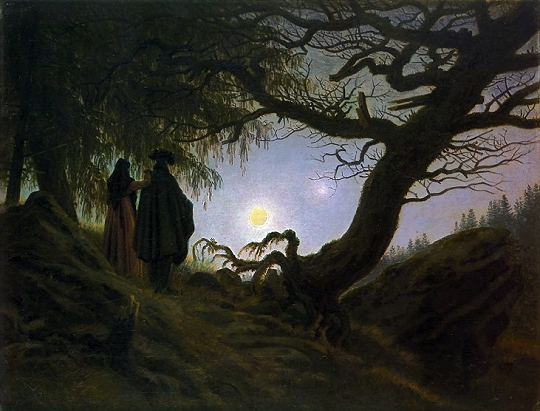
|