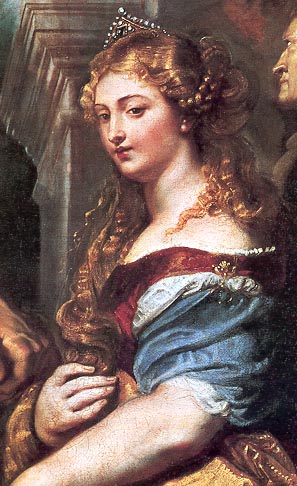
The following is a chronologically-arranged selection of visitor feedback about this Web site, including answers to the question that I have posed on the Timeless Beauty page. My own responses appear in italics.
This page archives comments received from the creation of this tribute in December, 1998 until September, 2000. Visitors looking for comments received after September, 2000 can find them at the current Your Comments page.
[Selection: Lorna Roberts] All of the women [on the Judgment of Paris page] are absolutely beautiful! My personal second choice would be the un-named model. I asked my teenage sons, they think Liis is a “BABE!”
Your Web site is very beautiful. I love the background and the quotes. Am currently reading Jane Eyre for a college class. I wish I had lived a hundred years ago—I would have been cherished, and not put down for my womanliness (size 1X).
Terri, Columbia, South Carolina (1998.12.16)
You're in for a real treat then, because Jane Eyre is one of the five greatest novels ever written. Brontë herself—understandably envious of the adulation universally bestowed on such women during her own lifetime—is not always charitable toward her full-figured beauties, but she never fails to describe them in the most alluring terms. And yes, standards of beauty were very different in the last century—and in every century before this one. But guess what? The twentieth century is almost over, and the guilt-based androgynous ideal of the last few decades has run its course. The aesthetics of true, opulent feminine beauty will reemerge, no matter what vested interests attempt to prevent this from happening.
My choice is Liis. However, I do want to add Emme. I have met her several times at the Ms. Plus USA Pageant and there is greatness in her presence and her style.
Barbara Harris Williams, RN (1998.12.20)
[Selection: Kate Dillon] Kate Dillon is so beautiful and I love her red hair. She looks great in everything she models. I'm so glad she's representing the plus-size women of the world. All the models are great looking. But there is just something about Kate that tops them all.
Anonymous (1998.12.21)
I agree that she is beautiful. However, even though I have posted that beguiling picture of Miss Dillon in front of the dessert tray, she was even more attractive in her earlier MODE shoots, in which she had longer and blonder hair, and was somewhat fuller figured. This was a look that suited her particularly well. If you had ever seen her TV ad for Just My Size, which dated from about this time, and showed her posing in front of a mirror—just as she did in the corresponding b&w print ads that ran in MODE—you would have sworn that she was a living classical goddess.
[Selection: Kate Dillon] My nominations are Natalie…I forgot her last name, but she is the plus-size model for Elisabeth by Liz Claiborn and has been in almost every MODE magazine. I also nominate EMME. Why has she been left out? She has done so much for plus-size modelling.
Brooke (1998.12.21)
[Selection: Liis] One of the qualities that endears Liis to me, (my husband thinks she's hot) is that in her pictures one can see her change. Her weight fluctuates just like a REAL woman! She's truly beautiful. I only have one annoyance concerning “plus-size” models and that is that it seems models must have a “thin” face to qualify. Liis has gorgeous cheekbones and in most shots she has a jaw line. I've seen some incredible women with no cheekbones and no jaw line, but never in publication. Is this a standard or has it just been that a candidate with those features has not presented herself yet?
Wendy Crowley — dhalfo@tc3net.com (1998.12.23)
Liis is definitely at her peak of beauty when she experiments with a richer and fuller look. And I agree with you about the limitation you perceive on different types of facial features among models. Personally, I wouldn't trade a set of cheekbones like Liis's for anything, but a rounder face and a softer jaw-line can be quite captivating. My theory is that fashion photographers are still fettered in an Anglo-Saxon bias toward the thinner, oval face. But a more Germanic, or even Slavonic look, would be quite refreshing.
On a different note, fans will be pleased to know that Emme has now been added on this site.
[Selection: Emme] What's up with this page? What's wrong with plus sizes? I don't understand you Hollywood people who vote on celebs. Celine Dion is too skinny but Rosie O'Donnell is too fat and there's no one in between. This sucks!
Caroline G., a.k.a. “Kotek” (1998.12.31)
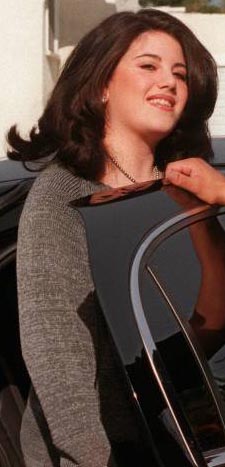
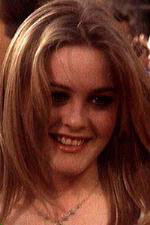
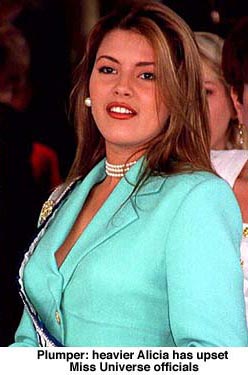
Good to hear from a younger respondent, and one with whom I concur. Because she's right. It sucks. There's no one in between. This is one of the most perplexing aspects of our culture—that size 14/16 truly seems to be the forbidden body for women to have. Less than that, and you're fine. More than that, and you're protected under the ægis of the “size acceptance” movement. But how often do we see a radiant, size-16 actress, or even a letter-turner? How often do we see someone of Monica Lewinsky's age and size in the media? Never. (And she's there only because of her dubious life decisions.) Remember what happened when Alicia Silverstone, or ex-Miss-Universe Alicia Machado started to develop classical feminine proportions? The media attacks upon them were merciless. Likewise for Kate Winslet. The beahviour of her character in Titanic was way off the mark, historically, but her womanly figure was not. Yet the insults levelled at Winslet for her weight, even by the director, were well publicized.
Something about these “in between” sizes, this specific kind of beauty, (this timeless beauty,) makes the Hollywood intelligentsia nervous. They retreat from it as if it were dangerous, perhaps even immoral. Hollywood denies femininity at every turn, and insists upon an increasingly androgynous standard of appearance and behaviour for women. The size-4 actresses are made to play curiously asexual, or even masculine roles, and the larger actresses are all turned into matronly “grande dames.” But that dangerous middle ground, that extravagantly and archetypally feminine 14/16 ideal, is forbidden.
That's why MODE magazine impresses me so much. From its inception, it has targeted the women who constitute this “invisibe” segment of the population, and has not shied away from presenting them in unapologetically sexy ways. By the power of its images, it is challenging cultural aesthetics, and will yet overturn them.
[Selection: Barbara Brickner] I love your pages and will visit here often!! Keep up the great work!!
Kelly J Kitchens, a.k.a. “Kelly!” — kellyjkit@yahoo.com (1998.12.31)
[Selection: Sophie Dahl] Sophie is a true Beauty in every sense of the word. She is 110% woman!!!!
Rick (1999.01.03)
Congratulations on your great site! I really enjoyed Liis!
Ilias Poupis, FashionAvenue Community Leader — maels@bigfoot.com (1999.01.04)
And I always enjoy getting feedback about my site—especially the positive kind, and especially from a genuine master of the Web, like Mr. Poupis.
[Selection: Kate Dillon] No contest! See more of Kate Dillon at the Totally Kate Dillon Site.
Joe Michaels — joemike@laoffices.com (1999.01.04)
On the contrary, there is more of a contest than you think. But Webmasters of other tribute sites can hardly be expected to be objective, can they? :) I provide a link to Mr. Michaels's wonderful shrine on my links page. (Do you now see what I mean about his infectious enthusiasm?)
[Your site] was interesting. I liked it. And when I get more time, I will definitely check it out more. The Liis chick is gorgeous. On a scale of 1-10 I give it about an 8 which is good because I'm harsh on Web sites. The thing I probably didn't like the most is on your links list, you unintentionally put some of the sites down. But it was very good. Maybe you should (when you get time) add more pages with more models.
Sherry — Ccane02@aol.com (1999.01.05)
On the contrary, I quite intentionally put some of the sites down—but only the official ones. I am trying to make a larger point about the battle that's being waged concerning the Internet right now; specifically, whether it will increasingly become the domain of business concerns, or remain largely in the hands of private enthusiasts. Technically, any contest between “official” and “unofficial” sites always ends in favour of the latter, which confirms my belief that if corporations push private individuals out of cyberspace, then the Internet will lose most of its creative vitality, and end up having no greater effect in challenging societal standards than does the business world itself.
This is not a Marxist argument, by the way—quite the opposite! My quarrel with the business community is that few corporations are doing what they should be doing—i.e., helping to provide a cultural counter-force against the increasingly prevalent, politically-driven movements that have as their goal the elimination of any semblance of beauty from this world.
As for adding more pages with more models, because the intention of this site is to link timeless ideals of feminine beauty with contemporary models who embody them, and because the media disparages these ideals, there are still only a few individuals in the public eye who qualify. The models selected for this site are those who are so manifestly attractive that, in another time, their beauty would have been venerated in paint, marble, poetry, or prose by the greatest artists of the Western world. I elaborate on this point in my new Timeless Beauty page. Check it out to see what I mean.
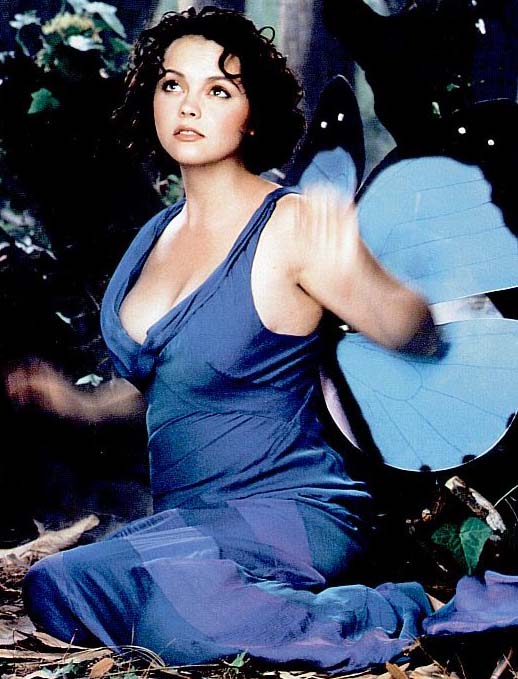
[Selection: Kate Dillon] I like Kate, Sophie, and Liis all so much it's a toss-up. I saw the previous comment that women the size of Lewinsky, Winslet, etc. are generally ignored in terms of representing values of attraction. We should all keep an eye on how Christina Ricci develops. She looked wonderful in The Opposite of Sex.
Tom (1999.01.07)
Your site is very good in its presentation, and in your use of literary quotations to hark back to an era more receptive to female beauty. I even think your responses to visitors' comments are tactful and positive. Not inclusive, but positive to those people who show an interest in your site. Plus-size models deserve recognition as icons of femininity. As for my favourite, I like the Addition-Elle model [Shannon Marie] most. She seems to have a wonderful combination of mischief and luscious femininity.
A.D.R. (1999.01.08)
You are very poetic. I like that. You're looking at the positive images, not the negative ones like the rest of the world. The pictures are nice. I can't believe how much Sophie Dahl looks like Lillian Russell. While I was looking there, my son came back into the room, and wanted to look at Liis :) He still thinks she's a BABE.
I like the dark backgrounds with the secondary colours. It makes the print and pictures stand out. You're doing a great job.
I like that you took a positive look at these women, instead of comparing them with the likes of Twiggy.
Terri (1999.01.08)
Thank you for your generous comments, Terri. You were the first one who really understood the purpose of this site. And yes, it was definitely my intention to opt for a positive rather than a negative approach—such as comparing plus-size models with their minus-size counterparts. That would have been far too unfair to the latter! We should always be merciful to the waifs in the media, and say something kind to them, like “you have such a pretty face.”
Let no one say that I am without compassion…
[Selection: Kate Dillon] Fabulous site. I'm a painter and whenever I paint a female nude, I usually get asked—“but isn't she a little CHUBBY?” To which I respond with a resounding “NO!” I usually work from photos in artist's references, models costing what they do, and routinely add about 30/40 pounds.
Mary C. (1999.01.09)
Yes, and if only the models on whom those references are based would themselves gain 30-40 lbs., then there would be no problem. Depictions of the full-figured female nude comprise a long tradition in Western art, and I could include artworks to represent plus-size beauty from every era of Western history on my Timeless Beauty page, if I were to admit nude images on this site. However, I am just “not that kind of Webmaster.” :)
This is the neatest Web site I have seen. It compares the plus-size models of today with historically beautiful women, to show that we are neither the “new shape in fashion,” as MODE magazine (which I love) suggests, but timeless beauties who have always been adored!! I love it!!! :-)
Mary (posted on the Lane Bryant forum 1999.01.10)
BRAVO! I just went to your “Timeless Beauty” site…Your comparison between the current and classic beauties spanning the ages was phenomenal.
I think that [plus-size women] embody the true essence of the strong woman, and that has been threatening to most men in the twentieth century. When women didn't have the right to vote and make lives for themselves inside and outside the family structure…these strong women became more and more threatening. That to me is why the media started to celebrate the waif (and truly the weaker-looking) women like Twiggy in the 1960s and it has just perpetuated itself right on through to the end of this century! Thanks for this most FAB-ulous (and well-researched) page.
Kelly J Kitchens, a.k.a. “Kelly!” — kellyjkit@yahoo.com (1999.01.11)
And thank you so much for your effusive praise. What's even worse, though, is that it wasn't men who inaugurated this gaunt, unfeminine look at all, but women themselves—specifically, the “flappers” of the 1920s whose appearance coincided with that of the suffragettes.
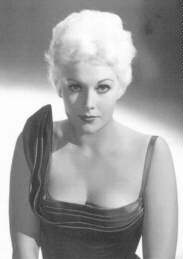
One of the most regrettable aspects of the so-called “women's movement” was its open hostility towards genuine femininity, and how it equated propagating a “masculinized” appearance for women with the attainment of political power. In the 1950s, when the women's movement wasn't as strident as it was before or afterwards, Hollywood began promoting some nearly-plus-size actresses, such as Kim Novak, and the dazzling Anita Ekberg. But once feminism organized itself into a political force in the 1960s, the media followed suit and revived the boyish “flapper” ideal, with Twiggy and her ilk. Since then, although the strength of feminism in the media has increased steadily since the 1960s, even to its current position of dominance, the androgynous standard has remained firmly in place. Regrettably, political feminism has always demonstrated a resentment-driven contempt for the female body, and for this reason, the “women's movement” and the “waif” look have gone hand in hand. If the two were not linked, the ascendency of feminism would have put an end to this asexual standard long ago.
To avoid controversy, I will not list the many theories about why old-style feminism pushed for this masculinized look. Suffice it to say that the reasons for adopting this boyish ideal were anti-aesthetic, and political in nature. Beauty was sacrificed at the altar of a supposedly “higher”—and in fact quite pernicious—purpose: the androgynization of society.
That is another reason why the existence of MODE is such a hopeful sign. It gets past the resentment-driven aspects of political feminism, and demonstrates what a true “women's movement” should be all about. The beautiful images in MODE celebrate femininity, rather than decrying it, or seeking to replace it with an androgynous ideal. MODE girls are not man-haters, or beauty-haters, and they are certainly not victims. They are whole, and healthy, and happy, and may be the first group of women in America in decades who have a genuinely positive image of themselves.
Thank you so much for posting your Web site. I have visited many times, and I get a nice confidence boost each time. It is wonderful!!
Vikki (posted on the L.B. form 1999.01.11)
I think our society, in general, is constantly trying to find ways to make “me” feel better about “me,” even if it means hurting others. Obviously, our physical bodies are an easy target. If you find a confident woman who is overweight, society tends to do everything possible to keep them from becoming too confident. They throw a slender women with dyed hair, coloured contacts, and not a real bone in her body in our faces to remind us of our—in their opinion, what should be—desperate attempt to become what they are. This generation doesn't recognize anything except that attempt to become better than everyone else.
Sarah Bailey — sarah.watters@oc.edu (1999.01.11)
Thank you for your perceptive analysis. If attempting to become better than everyone else were a process of genuine self-improvement, then there would be nothing wrong with it. But in this society, the impulse is not to become better by raising oneself to a greater height, but by “cutting others down to size” (in this case, literally). Your example of the beautiful and supposedly “overweight” woman whose confidence others attempt to shatter is right on the money.
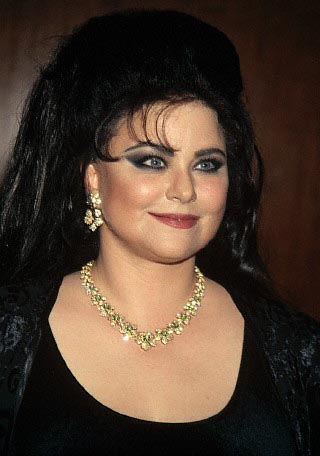
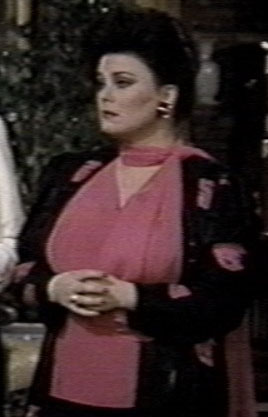
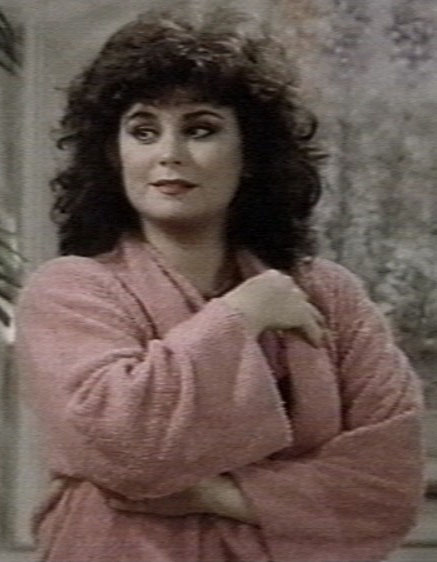
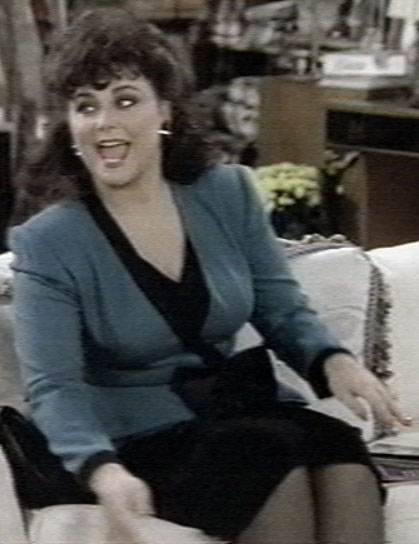
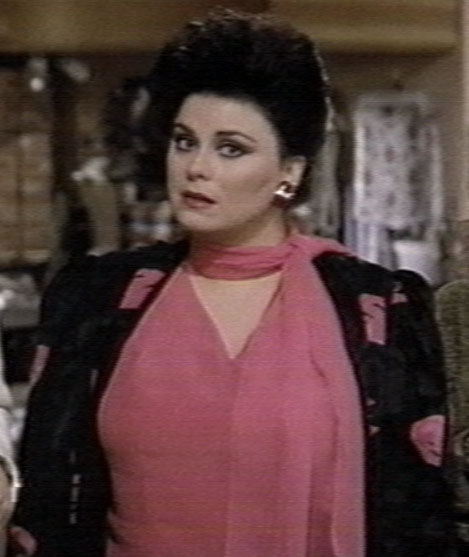
This is why Delta Burke—or rather, her character on Designing Women—was such an important factor, a few years ago, in shattering the “thin is pretty” illusion that the media perpetuates. Since Mrs. Burke's weight gain was not initially written into the show, the creative team was still writing scripts for the confident, “thin” Suzanne Sugarbaker, even though she was visibly putting on weight—which, in Hollywood, was never supposed to happen! Thus, by accident and not by design, America got to see a character who was full figured, but still dressed alluringly, and was no less attractive than before—indeed, moreso. But what was most revolutionary of all was Suzanne's awareness of her own beauty. She was gorgeous, and she knew it. Small wonder, then, that although Suzanne was supposed to be the “flawed” character on the show, serving only as a foil for the other, more morally- and politically-correct members of the ensemble, everyone loved her the best.
Eventually, of course, the writers recast Suzanne in a less elegant mould, which decreased her subversive effect. Nevertheless, for several seasons, there was at least one character on television who was not the least bit apologetic about her size or her beauty.
Wow! Thank you for the inspirational lift—I feel more gorgeous than ever! :)
IndiaX — IndiaX@aol.com (posted on the L.B. forum 1999.01.11)
I am completely in love with this page. If you want to travel deeper into time, I know of some excellent GIFs of the agricultural goddess statuettes that hint at the pre-historic aesthetic appeal of the mother/lover/goddess=woman. In fact, you might consider joining with other who value this subject in a Web-ring of sorts…me included, possibly. Tell me what you think!
Maura — kittychick@aol.com (posted on the MODE forum 1999.01.11)
The only ring that I believe in is Wagner's Ring of the Nibelung. :-)
Seriously, though, Geocities offers a very limited amount of disk space, so some decisions had to be made about what could and could not not be treated here. As stated on the Timeless Beauty page, this site restricts itself to an examination of Western culture. However, this decision is not as arbitrary as it may seem. Today, many societies have more positive notions of feminine beauty than the West does—especially than we do, here in North America. What is worse is that, because of the global dominance of our media, we are exporting our negative standards everywhere, and infecting other cultures with our guilt-based malaise. This site endeavours to demonstrate what any student of history knows—that our aesthetics of guilt are a recent aberration, flying in the face of the artistic legacy of our own culture. We once had healthier aesthetic notions, however, and we will yet return to those.
The statuettes to which you refer have become famous not as aesthetic icons but as political icons. And while the movement that uses them as their emblem may have sympathetic goals, it would not be in keeping with the intention of this site to display them here. However, I sincerely encourage you to embark on your Web ring project. Your site may offer a different perspective on certain issues than mine does, and that can only be a good thing. Find the images that are graven in your heart, and reveal them to the world.
Thanks for a great Web site. I enjoyed it completely and those women are gorgeous and so am I.
Lisbeth — raine_4@hotmail.com (posted on the L.B. forum 1999.01.12)
What a great site! I am a fan of the marienwerder sites. This page with the beautiful pictures and commentary is JUST what I needed!
Helen Paris — helenparis14@hotmail.com (posted on the L.B. forum 1999.01.12)
Plus size beauty is just not traditional. If you are plus size the first thing that people will say to you is, wow, you are a very beautiful woman, you just need to lose a few pounds. I hear that all the time and it makes it difficult to be secure in being big and beautiful.
Meniece — meniece@excite.com (1999.01.13)
Translation: “You need to lose a few pounds—to limit your beauty to within acceptable norms.” This levelling impulse is at the heart of the aesthetics of guilt that dominate our culture. Whenever people say things like that to you, it's not because they want you to be more beautiful, but less beautiful. They don't mind your being pretty, as long as it's in a meek, “Kate Moss” sort of way; not in an extravagant, “Liis” sort of way. They want to keep your beauty to within prescribed limits, to prevent you from becoming a goddess, and to make you descend to earth and remain…ordinary.
If all this sounds a little farfetched, remember that such levelling extends far beyond the sphere of feminine beauty. As Sarah stated above, people attack anything exceptional in our society, and attempt to reduce it to the level of the mundane. Minimalism has been the keynote of the latter half of the twentieth century—and what is minimalism, really, but the celebration of humility?
If there is anything that I hope visitors to this site come away with, it is the awareness that plus-size beauty is traditional. It is part of a tradition that reaches back to the very beginnings of Western culture, permeates its entire history, and today is slowly emerging once more.
As for what people say, these days it is often difficult to restrain oneself from telling many women that they could be quite beautiful, if only they would gain a few pounds…
Great site! Only problem is it had a side effect: with all the great pictures of most of my husband's favourite models, how do I get him to stop drooling? LOL
Janaina — janaina@pobox.com (posted on the MODE forum 1999.01.14)
Wow! You're right, she's gorgeous!
Alex Turnbull — alext6@hotmail.com (1999.01.20)
[Selection: Sara Morrison] They were all beautiful…
Heather Warren — heathery@apex.net (1999.01.25)
Your site is absolutely wonderful! I really enjoyed it. It is refreshing to see a page that worships plus-size women instead of “minus-sizes.”
You might be interested in my little endeavour. I formed PlusModels about a week ago. It is a non-profit site dedicated to plus-size women who want to be models/actors. I have a member directory with photos and bios of aspiring plus models, tips about the business, advice, etc. I will certainly be linking to your site as it is a wonderful inspiration to the aspiring models out there. Sincerely,
Anne — plusmodels@aol.com (1999.01.28)
Well, I'm not usually given to letting people advertise their wares here, but since your site is not for profit, I suppose that one good link deserves another. And besides, you were so kind…
I think that [your site] is fabulous. I enjoyed the pictures (although they did take a while to load, but were indeed worth the wait) outlining [Liis's] career, and you are correct when you say that she does get more beautiful with each shot. I also agree with your opinion that the supermodels of yesterday had better look out. There is so much more “realism” (for lack of a better word at such an hour) in her body and face than what you get on the runway, or in Vogue and Glamour. She reminds me of the pictures of the Baroque and Classical periods of art, with the full-figured woman as the epitome of what a woman really looks like. (Funny how your page of “Timeless Beauty” just loaded when I wrote that sentence.) I have a friend of mine who refuses to let his seven-year-old daughter play with Barbie dolls because they give young girls a false sense of beauty and body image. I think he is smart in doing this because I have watched many programs on society's perception of weight and how eating disorders have plagued the young people of the past two generations since the introduction of Barbie and other dolls. Eating disorders are more prevalent among the youth of today than among any other generation, and although they can be traced back further, the rampant fad is most evident in recent times than ever before. I thoroughly enjoyed reading the excerpts from literature along with the pictures of the models, and when I get back to Canada I will sure try to get the names of the Cotton Ginny Plus and Addition-Elle models for you.
I want you to know that I honestly appreciated your page and thought it was wonderful. Blessings,
Samantha Ghostkeeper — veralynn@ulink.net (1999.02.01)
Wow! Yours is definitely the most comprehensive endorsement that I have ever received—and by the way, you have a wonderful surname. :)
I am delighted that you enjoyed the site so much, and I couldn't agree with you more about the pernicious influence of “Barbie chic.” That's why The Body Shop impressed me so much when they ran their famous ad, “There are 3 billion women who don't look like supermodels, and only 8 who do,” which featured a lovely plus-size doll reclining on a sofa. The doll's appearance was the secret to the power of that ad, because she truly looked happier, more radiant, and infinitely prettier than any stick figure ever marketed by Mattel.
Of course, the company could easily have taken the wrong tack, and displayed a doll that was self-consciously “ugly” in order to say “Down with Beauty!” or some other such nonsense. In fact, in a promotional publication from about the same time, The Body Shop also ran a very different ad, this one showing a beautiful-but-sad, fuller-figured woman sitting on a cold floor, and bathed in an unwholesome greenish light. Images such as this epitomize the politicized, “victim” approach to size acceptance, and can only help to perpetuate bad feelings. The sentiment is commendable, but the technique is not. By contrast, in the “doll” ad, they adopted a positive rather than a negative stance, and made an affirmative, MODE-like statement. It's just another example of good business practice—using aesthetics instead of politics to send out a positive message. Well done.
[Selection: Emme] Where can I get information on plus-size modelling? Any help you an give would be greatly appreciated. Just e-mail me at Jespunk@aol.com Thank you!
Jennifer L. Homrich — Jespunk@aol.com (1999.02.14)
I wish I had any information to give you, but unfortunately, I do not. My interest in this subject is purely that of an amateur enthusiast, and I have no ties with, or knowledge of, the professional modelling world. Perhaps you could try contacting a modelling agency in your area. They might at least be able to direct you to an appropriate source of information. Also, I believe that Christine Alt's Web site (which I have listed on my links page) offers a few preliminary pointers about the business, for those who are interested.
Setting up unrealistic “ideals” of beauty pumps billions of dollars into the diet industry. The more impossible it is for women to achieve the ideal of a slender body the more subject women become to insecurity. The more insecure women are, the easier they are to influence. The media thus influences the purchase of items that would lead to this “slender ideal” and the cycle of insecurity perpetuates itself and continuously pumps this billion-dollar industry. How the cycle began is another subject I have yet to ponder deeply.
Anonymous (1999.02.15)
Normally I resist posting anonymous comments, but this response was so well thought out that I simply had to share it. I also endorse the opinion wholeheartedly, and if mine were not a strictly disinterested and nonpolitical Web site, I would point out that the diet industry is far more culpable for spreading societal malaise, and does much more damage to the social and psychological well-being of North American women, than any other commercial enterprise—even the tobacco industry.
As to the responder's question about the origin of this cycle, I think the answer can be found in the life of Lillian Russell (whom visitors will know from my Timeless Beauty page). Her career extended past the end of the nineteenth century and continued into the twentieth, so she experienced first-hand the effects of the change in North American culture from the celebration of true beauty to the promotion of false beauty. Nothing pinpoints the source of this change better than the following quotation from the movie journal Photoplay, which I came across in a new biography of Miss Russell by Armond Fields. It is an excerpt from a review of the film Wildfire, in which Miss Russell starred:
When one sees her, one realizes how fast our standards of beauty have changed. Together with militant suffrage and the feminist movement has come the ultimatum that a beauty of the twentieth century must be lithe and slim and boyish, and Lillian Russell still adheres to the princess gown which fits, without a wrinkle, the lines of a “perfectly molded” figure.
I wonder if the writer had any idea how prophetic his words would be. With only a few minor fluctuations, his prediction has held true for the length of the twentieth century. Why feminism—which was supposed to be a movement of women's liberation—instead began a century-long attack on women's self-esteem is another question that deserves asking (and answering), but the fact remains that the responsibility rests squarely on its shoulders. Current feminist efforts to shift the blame onto that chimera they call the “patriarchy” are historically inaccurate at best, and deliberately mendacious at worst.
But thankfully, all this is now at an end. The sands in the hourglass of the twentieth century have almost run out, and if you will permit me to make a prediction of my own, the twenty-first century will see a return to true beauty—to timeless beauty—and not just in the realm of feminine aesthetics, but in all the arts. It will be a glorious thing to see, and it can come none too soon.
[Selection: Kate Dillon] In all honesty, it should be an 11-woman tie. These women truly are the most beautiful in the world (not to mention my wife).
Anonymous (1999.02.18)
Okay, new rule: no more anonymous messages get posted! I just wanted any female visitors to this site know that there most certainly are men out who don't merely say that they prefer plus-size beauty, but prove it by their choice of a significant other.
[Selection: Kate Dillon] I must say that this is quite an impressive Web site—almost as impressive as the beautiful women that it has been created to celebrate. I think the classical references are a brilliant touch, establishing just how timeless the beauty of these women truly is. A great production all around, and please count my vote for Kate Dillon as the fairest of them all. Please keep up the good work.
Anonymous (1999.02.22)
Well, perhaps one more…
Just saw your Barbara Brickner gallery for the first time. Now I understand what you have said about her. She has the most breathtakingly, exquisitely, perfectly beautiful body one could imagine! And she is obviously very comfortable about showing it off. I think she should be on the cover of a plus-size swimsuit calendar!
Joe Michaels — joemike@laoffices.com (1999.02.25)
Well, if Mrs. Brickner's pictures can make even the Webmaster of a Kate Dillon tribute page forsake his idol for a moment, then her beauty must indeed be superlative. Whenever I ask questions like, “Why does no one create sculptures possessing the beauty of the Venus de Milo any more,” I am frequently told that it is because women are no longer that beautiful, nor are sculptors that skilled. Thankfully, the existence of Barbara Brickner belies the former assertion. Now, if one could only persuade MODE to publish a swimsuit edition of its models (and furthermore, if one could somehow persuade Liis to participate in such an endeavour), then perhaps we would shatter the “gaunt is attractive” myth, once and for all.
Think of it: the MODE Swimsuit Edition. It would have an effect on the modern publishing world similar to that of the detonation of a bomb. Could there be anything more radical, or more wonderful?
The diet industry and fashion industries [are responsible for the resistance to plus-size beauty.] They need and feed off each other. The fashion industry sells women a false notion of beauty, and the diet industry sells them what seem to be the means to attain this “ideal.” It's all about the money. However, the fashion industry is now starting to realize that there is actually money to be made from real (and the majority of) women. Just my two cents! Regards,
Sean Moore — hoodlum_za@yahoo.com (1999.03.07)
Absolutely correct. I am always impressed when anyone sees through the deception of diet-industry propaganda and understands the weight-loss industry for the monster it really is. Consider the situation by way of an analogy: everyone knows that Beethoven's symphonies, like Shakespeare's plays and Michelangelo's sculptures, are among mankind's most beautiful creations. But if the media were persuaded (by an industry with big advertising revenue) to trick people into thinking that they were ugly—and then all the newspapers, and all the magazines, and all the TV shows and movies started engaging in this deception—then it would only be a matter of time before most people would be brainwashed into agreeing, however much their better judgment told them otherwise.
This situation is identical. Sheer instinct (and common sense) tells us that “starvation chic” is a false ideal of beauty. But if the fashion industry pretends it isn't, and all the branches of the media support their aesthetic fiction, how can anyone be expected to see outside this deceptive bubble? In the final analysis, that's how the weight-loss industry gets its money—by tricking women into thinking that their naturally beautiful figures are ugly. Thank goodness that publications like MODE are finally exposing this fraud, once and for all.
[Selection: Emme] I am a new model, and I adore (and look up to) not just Emme, but all these women. I think this is wonderful, and I hope that soon, I too can be judged on a site like this.
Jennifer VanWinkle — RipLee911@AOL.com (1999.03.09)
Best of luck with your career. I hope to see you in many publications!
When Twiggy arrived on the scene it was apparent that the anorexic look could be used as a major marketing tool. Everything from thigh-slimming cream to diet books were the rage and, unfortunately, the public bought the “snake oil,” hook, line, and sinker. Because most of us have been brought up on abnormal images of women (these tiny women only exist in a minuscule percentile of the population) we believe that they are the “norm.” Being thin is associated with worthiness and happiness, and fuller figured with being miserable and unworthy. They media is resistant to plus-size beauty because it was the very vehicle that brainwashed us against it—the “flesh is bad, bones are good” mentality. They media is run by sponsors that have made (and are making) money off public insecurities. The more we hate ourselves, the more money they make off our backs, and the cycle continues. Our self-loathing was induced and is sustained by the media. For some reason, they haven't figured out another marketing technique that will be inclusive of all people instead of being destructively exclusive. For many years, I have fought against myself because of what other people said I should look like. Today, I love my Botticelli curves and my Bouguereau face. My fiancé says I'm beautiful now, not when I lose that extra weight. I'm healthy and I have a wonderful life. My attitude is what the media is afraid of. I have formed my own judgments and opinions. I do not rely on externals anymore, and this includes the media. And where would they be if others refused to listen? (We can only speculate.)
Tracie Lynn Eliuk — mickandtracie@sprint.ca (1999.03.10)
Brilliant answer. Simply brilliant. The media certainly should be afraid of Miss Eliuk, because she, and girls like her, have finally shed their cultural conditioning, and are seeing plus-size beauty as genuine beauty. This is an epochal societal shift, because they are the first generation of North American women to realize this in almost a hundred years. Miss Eliuk is obviously neither a puppet (which is what the media wants her to be) nor is she a victim (which is what feminism wants her to be). She has looked in her mirror, and seen qualities there that no diminutive waif could ever match. She is not ashamed of her femininity, but glories in it. Is it any wonder that her fiancé adores her?
Incidentally, she also displays great taste in art. Bouguereau once famously said of the French Impressionists that their paintings were “no more than unfinished sketches.” Renoir excepted, I tend to agree.
People don't know what real beauty is. They see television stars, and movie stars, and they think that the only way to be pretty is to be thin. They don't look at the other countries where people would kill to be able to look healthy. Ignorance, it's just pure ignorance that causes them to act this way.
Amber Davis — ginni@n2trouble.com (1999.03.12)
Miss Davis makes an excellent point. If people are kept ignorant of the tastes of other cultures (or other times) besides their own, then they will uncritically accept the norms of their own milieu, no matter how off-kilter they may be.
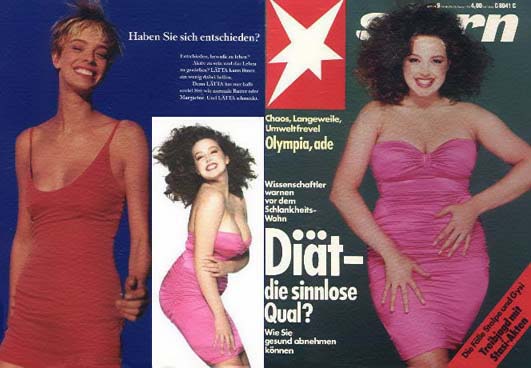
I promised that I wouldn't do a “comparison” like this, but someone recently drew my attention to the following item, and I can't resist sharing it. It's a scan of the front-and-back cover of an issue of the German periodical Stern. Compare these two models. The one on the left is so thin she looks ghastly, while the one on the right (and in the insert) looks healthy and beautiful. The magazine's headline is very fitting, “Diet: The Senseless Suffering.” And it really is senseless, isn't it? What girl could possibly want to torture herself with weight-loss strategies and end up looking worse, like the model on the left, when she could just eat according to her natural appetite and look better, like the model on the right? This cover also shatters the myth that fashion models must be gaunt because clothes look better on emaciated bodies. In fact, it is the plus-size model who makes her dress look elegant and feminine, while the minus-size model makes hers look ungainly.
The European media acknowledge the superiority of the fuller female figure, and it's high time the North American media did so as well.
[Selection: Ariana] I think there are a number of reasons why the media resists plus-size beauty. One is that the philosophy of the Western world for the last couple of centuries has been one of conquering nature and bending her to the will of man. Traditionally, women have been symbolically linked with nature, and so the control of the female body is psychologically connected to the control of nature. A “natural” (i.e., out of control) feminine form is therefore an affront to Western progress. Another factor may be that the fashion world is dominated by gay men and this affects the aesthetic sense of the fashion world. I think the main reason, though, has to do with the psychological manipulation that is part of modern marketing. Sales is based on creating a sense of need and then convincing the potential customer that the product will fill that need. This tactic is used whether you are marketing insurance, cars, or cosmetics. Since the majority of women do not fit the Vogue “ideal” of beauty, this is precisely the ideal that is held up to make them feel inferior, thus creating a sense of anxiety to be assuaged by “going shopping.”
David Damrose — Damroze@excite.com (1999.03.16)
This is a multifaceted and extremely perceptive answer. Your “marketing” observation is well taken insofar as it applies to the weight-loss industry; however, not only is “going shopping” not a part of the problem, but considering the more provocative yet feminine designs that are being created in plus sizes today, it can even be part of the solution—i.e., by shattering the “frumpy” stereotypes about full-figured women, and helping reveal their matchless allure.
On the other hand, your comments about the “control” of the female body are highly significant, and remind me of a topic that Simone Magnus brought up on the “Lydian MODE” page. However, your hypothesis requires two important qualifications. First of all, much as Western man has tried to tame nature, he has always appreciated it most in its wildly out-of-control state. (And who can blame him?) And second, the “thin is beautiful” deception is a product of the twentieth century, and none other. Since Western man has sought to tame nature since the beginnings of his history, he could only be deemed the culprit if female thinness had been idealized for all of that time. However, as my “Timeless Beauty” page demonstrates (and as any student of history knows), this was simply not the case.
As I have stated before, the grim fact is that is wasn't men, but women who originated the celebration of the emaciated female form (i.e., the suffragettes, and the “flappers” of the 1920s), and it was other women who perpetuated it (i.e, the proponents of the feminist movement). To this day, it is widely acknowledged that women are far more abrasive and hostile towards exponents of plus-size beauty than men are.
Having said that, your point about the homosexual influence on (one might even say, dominance of) haute couture is controversial but incontestible. An awareness of this is central to a true understanding the problem of weight and the fashion industry. We should never forget that people will, by nature, defend the aesthetics that appeal to them most. Is it any wonder, then, that gay fashion designers favour models that have boyish figures? Not at all. And there would be nothing wrong with this, either…except that it results in the prioritization of an unfeminine and artificial standard of beauty, which in turn causes the needless suffering of millions of genuinely beautiful women.
[Selection: Kate Dillon] All of the ladies are beautiful, of course, especially Liis, but none compare to Kate Dillon. She has a pure, wholesome, “American” beauty that is hard to deny. As an example, I was looking through this month's issue of MODE magazine, when I came across a photo of Miss Dillon. I was knocked out! So much so that I e-mailed MODE to find out the name of this wonderful lady. They wrote back, listing all of the addresses to visit dedicated solely to Miss Dillon. Is she the most beautiful in all our world? No, she's number two—just behind my wonderful wife.
Leo W. Bratton — aegis777@excite.com (1999.03.17)
Hmmm. Your enthusiasm is commendable, but I have to wonder what you mean by describing Kate Dillon's beauty as “American.” For example, although Liis is a Canadian model, her full name (Liis Windischmann) suggests an Estonian heritage, which would make her either Germanic (if she is descended from the Teutonic Knights who crusaded into the Baltics in the Middle Ages) or Finnic (since the native Estonians are ethnically and linguistically linked to the Finns). Therefore, we may describe her beauty as “Germanic” or “Finnic” with a reasonable degree of confidence. On the other hand, since all inhabitants of North America are immigrants (from however long ago), there is no such thing as an inherently “Canadian” or “American” quality of beauty. True, Lillian Russell was always referred to as “The American Beauty” in her day (in fact, the “American Beauty” rose is named after her), but that was a century ago, when Anglo-Saxon was the recognized ancestry of the majority of the citizens of the United States. Today, this is no longer the case.
On the other hand, if you meant “American” not in terms of ethnography but popular perceptions, then the beauty of Kate Dillon is not American at all. Just a glance at any magazine rack will tell you that androgyny is the reigning standard of “beauty” (if it can even be called that) in the United States. Kate Dillon's loveliness—like that of all plus-size goddesses—transcends America's current guilt-ridden, apologetic climate, and harkens back to the extravagance of past ages, and European cultures.
Fortunately, as your own comments indicate, Americans are slowly realizing that the type of “beauty” their media deceives them into accepting is just that—a deception—and are ready to embrace plus-size beauty once again as their national standard.
[Selection: Lorna Roberts] I would like to nominate Mia Tyler.
nnorbert@hotmail.com (1999.03.18)
Any seconds on that?
[Selection: Ariana] I think everyone has grown up thinking women have to be thin, and to be in Hollywood you still don't get accepted if you're heavy. But I think big is beautiful, and it is going to change.
Lisa Zareczny (1999.04.01)
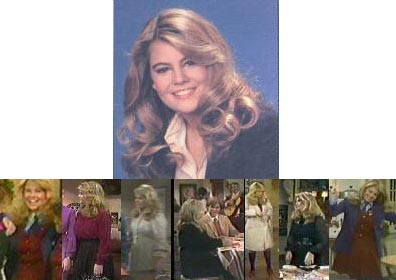
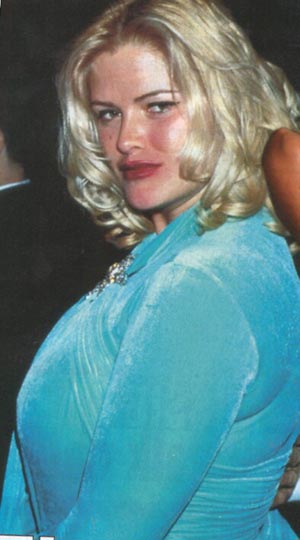
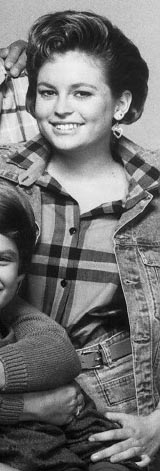
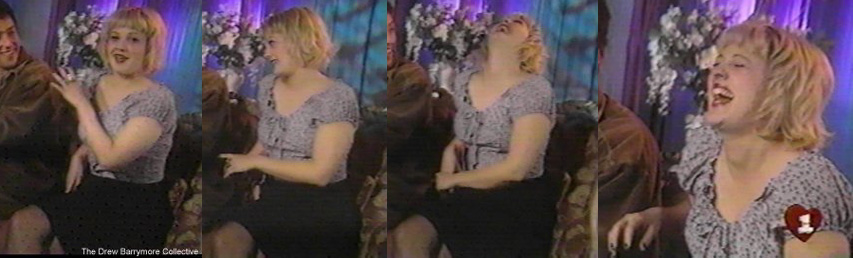
Big most certainly is beautiful, but let's not forget that words like “big” and “heavy” are relative terms, and that Hollywood's standards for what it considers “heavy” are simply ludicrous. The number of actresses whom Hollywood has castigated for having natural (let alone “big”) proportions is frightening. Most of us will remember the hostility directed at Lisa Welchel, who played the Blair on The Facts of Life, but censure has not escaped many other well-proportioned actresses, including Candace Cameron (of Full House), Shannen Doherty (in her 90210 days), Jamie Luner (of the short-lived series, Just the Ten of Us), Sara Rue, the infamous Anna Nicole Smith, Angela Watson (from Step by Step), and Tracy Wells (in the long-running sitcom, Mr. Belvedere). All of these young ladies began developing classical figures at some point in their careers, and one by one they were browbeaten, slandered, and otherwise harassed into conforming to Hollywood's artificial norm. That's why it's especially nice to see girls like Drew Barrymore on screen today—actresses who, while by no means “heavy,” do break from the uniformity of Hollywood's minimalist aesthetic. It is a healthy trend, and one that has been a long time coming.
[Selection: Kate Dillon] Kate Dillon truly is an inspirational model, not only because she is so stunning, but because she experienced the thin life, and decided for herself how she felt comfortable. I have been plus-sized all my life, and believe that if given the chance, I would at one point have sold my soul to the devil to be thin. Kate didn't sell out on herself. She is the ultimate woman.
I think that plus-size beauty has in many ways been shunned due to the “Less is More” quotient. Women are much more tolerant of weight than men are. Men in many ways regard women as trophies. Someone decided that the trophy must be “perfect,” and our standards of perfection are derived from the media. If magazine articles displayed normal-sized women, and if plus-sized models started at the size of 14 or 16 rather than 10 (which certainly is not large), the general public might slowly allow healthy, rounded women back into their rightful place of beauty and awe. One day in the future, I predict that the woman of desire will once again be a rounded, voluptuous, maternal figure.
Heather Anne Johnson — h_johnson@hotmail.com (1999.04.02)
Thank you very much for your optimistic appraisal. I agree with you wholeheartedly that size 10 is not even remotely a plus size, and that full-figured models should definitely begin (not end!) at size 14 or 16. That's why the formal-wear company Onyx really impressed me when, in an ad they recently ran in Girl magazine, they used a curvaceous model for their prom dresses who was definitely not a size 10, or even a 12, and was not afraid to display her lovely arms—something many models still shy away from.
As to your claim that women are more tolerant of weight than men, I think the exact opposite is true. Sadly, women are far more hostile toward plus-size beauty than men are. If any pattern emerges from even a casual survey of women's fashion forums, it is that no one is as resentful of full-figured goddesses as women who have starved themselves into unnatural, single-digit sizes. The psychology for this is obvious: “How dare you accept yourself?” the thinness-obsessed women think. “How dare you see through society's deception, when I have been its dupe? How dare you realize how gorgeous you are, when I've been torturing myself with dieting and exercise? I want you to suffer like I have suffered!”
Personally, I suspect that androgynous women are so resentful of their more feminine counterparts because they secretly know that a “woman of desire” is a “rounded, voluptuous” woman. They intuitively realize their own deficiency compared to their more richly-developed sisters, and they obey their natural impulse to attack whatever makes them feel inadequate. It is envy, pure and simple—a sad but all-too-human reaction.
[Selection: Barbara Brickner] This is Kate Dillon. I just have to tell you I think this site is absolutely beautiful. The Awakening by Kate Chopin is one of my favorite books ever and I started to cry when I read my “entry.” Thank you so much for such a thoughtful and creative site.
with love and peace,
kate (1999.04.03)
While I personally agree with your view on the heavier woman as beautiful, I must say that I think it also has a lot to do with perception. I like a woman who thinks she is beautiful. There is something about the way they walk and act that I find very appealing. However, in my case, this also means that these traits are found in a thinner woman (as my girlfriend is a solid size 9). As an aside, I have also met some heavier women whom I do not consider attractive because of their own shame in their appearance. I guess what I am saying is that it is not only the size of the woman, but her view of herself as well.
Averren Randall (1999.04.04)
Mr. Randall makes an important point. A woman's view of herself plays a crucial role in determining how attractive she is. Let's not mince words here: vanity is extremely alluring.
Consider the case of two full-figured girls: the first one dresses in form-fitting clothing (and isn't afraid to show her arms), wears her hair long, and visibly and passionately enjoys every part of life—including her food. The other's wardrobe consist of self-effacing, body-disguising clothing, she crops her hair short, and she is morbidly self-conscious about every bite that she takes. Who do you think will capture every man's heart? The former, of course. True, there are some girls who are so beautiful that they would look stunning even in sackcloth and ashes. But for most, a healthy dose of self-love is a prerequisite for being loved.
[Selection: Liis] They are all beautiful!!! They all get my vote! All of them are an inspiration to women of size, style, and true beauty.
Carey — Cas54140@aol.com (1999.04.05)
[Selection: Sophie Dahl] Hello, it's wonderful to see plus-size women being acknowledged for being beautiful. It's about time! I am a plus-size model in Seattle and it makes me feel good about myself to see women with whom I can identify. All of the models on this site are gorgeous!
Margji — Planetmarj@aol.com (1999.04.13)
I think that [the media resists plus-size beauty] because of the huge payoffs that the beauty and fashion industry (as well as the weight-loss industry!) earn. These companies/individuals get rich off of the neuroses of women regarding looking pencil thin, and they are loathe to give it up.
clheather@aol.com (1999.04.21)
I am not sure if this is the biggest reason [for the media's resistance to plus-size beauty], but I do believe that if the media (and society) encourage women to put a lot of time and effort just into staying thin, then what else are they able to accomplish? I mean, if a woman is obsessed (and for many this is an all-encompassing passion) with dieting, does she have a lot of mental energy left to spare for other activities?
Lisa — lisaandron@hotmail.com (1999.04.21)
I cannot overstate the importance of Lisa's point. I disagree with her suggestion that the media do this deliberately to keep women down, but she is absolutely correct that this is nevertheless the effect. Even if we forget the fact that fuller-figured women are more beautiful than thinner women, the depressing amount of time that's involved with weight control should persuade women not to waste their lives on such a meaningless pursuit.
I wish every single plus-size girl would sit down and make a list of all the things that she would rather be doing than torturing herself with senseless starvation and exercise—and then do each of those things. You could be relaxing with a good book, writing a letter to a friend, calling someone you love, dancing, seeing a movie, going out to dinner, painting, playing a musical instrument, going for a walk in the park, or just kicking back in front of the TV. The possibilities are endless. And if you really want to do something to feel refreshed and healthy, then catch up on some lost sleep. You'll feel much better than if you deny yourself food, I promise. All we have is one life—so live it!
UPDATE: While showing a friend your site, I couldn't help but notice (and be pleased) that you had included my comment on your page, along with a response. I must admit that after reading the other comments that you have posted, I am surprised that you disagree with my assertion regarding the deliberate nature of the media manipulation. I do admit that feminists have been using similar arguments about anything and everything, but in this case I actually believe that it is true—especially after considering some of the comments regarding the collaboration with the diet and advertising fields. So while it may not specifically be the media that is doing the manipulating, I am sure that someone is. And perhaps this is only a small part of the greater picture.
Lisa — lisaandron@hotmail.com (1999.05.21)
I agree completely that there is overt manipulation going on. My point was not that the media aren't doing this deliberately; it is that they aren't doing this deliberately to keep women down, i.e., preventing them from becoming president, or curing cancer. In other words, they are doing this deliberately, but for a very different reason.
This is more important than mere hair-splitting, because it ties with the attempts by modern feminists to appropriate the “size-acceptance movement” for their own ends, even though it was their movement that was responsible for making women unhappy with their bodies in the first place. A feminist could (and would) spin Lisa's original point to say something like, “Weight-control propaganda is a tool of the patriarchy, which tries to keep women down.” But the truth is the exact opposite, because (contrary to popular belief) most of the media is not the tool of some chimerical “patriarchy,” but of special-interest groups—and of feminists in particular.
As another responder states below, the ideal of most men is the Marilyn Monroe figure, or heavier. But by compelling women to lose weight, the feminists advance their efforts to androgynize the world, to blur the distinctions between the genders, and to efface the femininity of women everywhere. Furthermore, this is their resentment-driven way of “striking back” at all of the women who are the ideal of men everywhere.
So instead of the purpose being to keep women down, it is rather to advance one type of woman (the androgynous feminist ideal) at the expense of another type of woman (the feminine ideal).
[Selection: Sophie Dahl] She is definitely a fuller-figured Christina Ricci. But what's this about Sophie Dahl losing weight!? How small has she gotten? Do you have any recent pictures? What was she thinking?
Carol Antoine — fashionb1@mindspring.com (1999.04.21)
Good question. I do have recent pictures of Miss Dahl, but I refuse to post them. Hers is a case that is all-too-common among celebrities: she was heart-stoppingly gorgeous as a size 16 (which is still rather small), but became a rather ordinary-looking woman at size 12. Anyone who doesn't believe my credo that “plus size equals plus beauty” should compare the formerly breathtaking Miss Dahl to her much-diminished current self. By losing weight, she also lost much of her beauty. What's sadder still is the fact that if she were to gain back her weight, she would gain back her beauty as well. But since Miss Dahl seems vulnerable to society's skewed notions of attractiveness, she probably won't.
Here's to all the plus-size models who revel in their opulence! They know the true face of beauty, and they see it every time they look into a mirror.
[Selection: Sophie Dahl] Very wonderful and good-looking girl. Best model I've seen. I love her because I'm very bored with anorexic models and very slim girls.
Donald — basalto@yahoo.com (1999.04.29)
Hello. A friend of mine found your pages on the Internet and told me that you had pictures of me. I have to say that I am flattered by the description. I am intrigued about the source of the pictures, but I don't mind, as it is a great advert for me.
Lorna Roberts — c/o Katharine@Routh94.freeserve.co.uk (1999.04.30)
[Selection: Lorna Roberts] Fantastic Web site. I am a size 18, and it's good to see a positive site for big women. Keep up the good work.
Joanna Buttery — hanwell.sales@btinternet.com (1999.04.30)
I agree with your analysis wholeheartedly! However, after twenty credits worth of Art History and a ten-year obsession with historical costume, I must point out that one critical point is missing—a point that could “tip the scales” of the modern media.
The corset. Women wore them regularly (and documentably) for eight hundred years, until the 1920s popularized the androgynous figure, the debutante slouch, and the modern bra. Having reconstructed, designed, and worn corsetry at various times, I can tell you that eight hundred years of history will breed into a woman the natural desire to have a snugly-laced garment about her waist—and breed into men the natural fascination with unlacing!
Had I been born a century ago, I would have been every portrait-painter's dream. I'm 5'4", 36-26-38, with waist-length strawberry hair, large eyes, and an oval face. But in today's society I would never dream of becoming a model! In fact, I avoid cameras whenever possible. One of the main reasons for this is that modern clothes attempt to hide, rather than emphasize, a curvaceous figure. I have a wonderfully-shaped waist and a natural hourglass figure, but that is all lost under even a well-tailored modern dress.
Despite a lot of publicity given to the health effects of tight lacing, most women in history did not lace themselves into excruciating pain. They wore a snug garment which emphasized—or added—curves in all the right places. In all of the beautiful figures of yesteryear that we see, women are either corseted, or nude (except for a brief flirtation with a half-corset from 1795-1815). This is specifically because the curve of the woman's bust, wait, and hip was the object of greatest beauty, and had to be either displayed openly, or emphasized under material.
Imagine my happiness to see three different magazines in the past year which feature cover models wearing modern corsetry designs. The problem was that these models are so thin and muscular that a corset does nothing at all for them! They have no curves to emphasize. But the interest in the corset is reviving, if slowly, at the same time that the interest in plus-size models is picking up.
If we could simply combine the two, the media would be so much more tempted to pick up on the imagery! A snugly- (not tightly-) laced corset would emphasize the best features of plus-size models—their curves!—as well as hearkening back to the age-old images of beautiful women in clothes that were made for women, rather than clothes made for men that were modified to fit women. In our high-tech society, what could be more artistically eye-catching than a return to the feminine form?
Eve — MaraMaye@aol.com (1999.04.30)
Hear hear! Thank you for such a well-written and thoughtful response. With your measurements, however, I find it hard to believe that you have any hesitations about modelling, except to wonder if you are not too slim for the plus-size category.
Eve's point about modern clothes hiding rather than emphasizing a curvaceous figure is sadly true. The advent of MODE, coupled with Lane Bryant's efforts to target a younger audience, have improved the situation somewhat, but many beautiful full-figured women still seem regrettably tempted to drape themselves in as much fabric as possible. In doing so, they only disguise their most attractive features—i.e., their rich curves. For example, a woman who is a size 22 looks far more appealing in a pair of fitted jeans than does a woman who is a size 2, and certain designs that were intended to accent a woman's décolletage—like V-neck sweaters—frankly look ridiculous on women who have no cleavage to accent.
As for the corset itself, I wouldn't oppose its return if it meant that more overtly feminine designs were to come back into style along with it. However, I would never want it to become a mandatory part of womens' apparel once again. A woman with a generous waist measurement is by no means unattractive. For example, while Lillian Russell wore a corset in most of her photographs, there is one famous image of her uncorseted, showing that her natural waist was by no means small. However, she looks so relaxed and languid in the photograph that her beauty is in no way diminished. If anything, it is enhanced.
Like every other form of artistic expression, women's clothing was infinitely more appealing a century ago. Who can forget Kate Winslet's wardrobe in Titanic? Who could not favour the styles of that era over the waistless career-wear that designers still inflict on full-figured women? But as the century of Pollock and Schoenberg and Mies van der Rohe ends, we see that people like Eve have finally tired of ugliness, and are ready to welcome beauty back into their lives.
I was a size 6 model in the 1970s. Today I am a size 14 (and not a model). I cannot stand to look at myself in any photograph now. I don't think that fat is attractive. And I don't think skinny is attractive either. I envy the women who love their largeness. I am not one of them.
The Western definition of “ideal” beauty varies from very thin to “healthy.” It is women who perpetuate this ideal as much as men, if not more. The ideal for most men is the Marilyn Monroe figure.
I am only talking about superficial beauty here because that is the image that sells. Inner beauty is an entirely different matter.
garifw@connectexpress.com (1999.04.30)
I debated whether or not to post this responder's comment, since her opinion of herself is simultaneously sad and completely absurd, since size 14 can barely even be called a plus size, and the idea of someone not being able to look at themselves in photographs for this reason alone is utterly ridiculous. If the responder doesn't believe that skinny is attractive either, then how could she stand to look at herself when she was a size 6? I hate to say it, but I think that this responder is confusing her frustration at succumbing to the natural aging process with her increased dress size.
On the other hand, she is correct in her statement that it is women, not men, who are most responsible for perpetuating the genuinely ugly “ideal” to which the West stubbornly clings. If anyone should have a hard time looking at themselves in the mirror, it is the minus-size models who (to the lasting shame of this century) continue to grace the covers of our fashion magazines. I hope that many of these starving models have some kind of inner beauty, because superficial beauty they definitely do not have. For that kind of beauty one need not even look to plus-size models, but merely to the lovely girls that frequent North American shopping malls. Because today, we are witnessing a peculiar phenomenon whereby most cover models are far less attractive, not more attractive, than even many “average” women.
And if only women were to realize this, then how unfortunate it would be for the criminals who run the weight-control industry! How sad it would be to see the empires that these ruffians have built on spreading aesthetic deceit and societal malaise crumble. It couldn't happen to a nicer bunch of vultures…
One other important item to note about this responder's comment is that it reveals the generational nature of the differences in opinion about feminine aesthetics. If she was a model in the 1970s, then this responder is a member of the baby boomer generation—a generation that was, and continues to be, completely brainwashed by weight-control propaganda. However, the women of Generation X, and even more so the girls of Generation Y—the generation that is now in its teens—are proving to be far smarter than their parents' generation. They are taking pleasure in their appearance. They are not wasting their time and money in gyms, but enjoying their lives—and their food as well. They look at themselves in photographs, or in mirrors, and they see the limitless beauty that is theirs. This is an entirely positive development, and if they preserve this freedom to eat what they please, and the confidence to look beautiful, all the way throughout their lives, then they will be the happiest and healthiest generation that we have seen in decades.
[Selection: Barbara Brickner] Angellika, who has been featured in nearly every issue of MODE magazine since its inception, is a gorgeous, original beauty.
Anonymous (1999.05.10)
When I visited this page for the first time, I felt so beautiful. I too am a “classically proportioned” woman who has struggled to see myself as beautiful and lovely all my life because I didn't happen to fit the Kate Moss media “standard” of beauty. Thanks to MODE magazine, and gorgeous models such as Emme and Kate Dillon, that has started to change. This is nothing wrong with female curves and there is certainly nothing wrong with women of larger sizes loving themselves, their bodies, and enjoying life. I want to thank you for this wonderful Web site, and I hope that other women—who once found themselves “too fat” or “too curvy” to be beautiful—will stumble across it and know that they, indeed, are gorgeous. Sincerely,
Marylou Verano — marylou@uclink4.berkeley.edu (1999.05.15)
Thank you for your kind words. I wholeheartedly agree with your sentiments, and am gratified when my site contributes to anyone's self-esteem. Furthermore, I am especially happy to know that my site is helping to overturn current cultural norms, because that has always been my intention. After all, calling someone “too curvy” is like calling someone “too beautiful.” There is no such thing!
[Selection: Shannon Marie] I would like to nominate my friend Kelly Elliot because I think she is not only beautiful, but kind and sweet too. Check her out at: www.plusmodels.com/Kelly.
Anonymous (1999.05.18)
Since this comment was made, the very pretty Miss Elliot has had some notable professional success, including signing with Ford 12+ in Los Angeles and making two ravishing appearances in MODE. Perhaps, with a little more exposure, she may yet become a candidate for Paris's judgment.
[Selection: Liis] I also think Mia Tyler is very pretty!
[The media resists plus-size beauty] because that was the standard set many years ago. Back when modelling first was used, men only looked at the full-figured models (since the size of the time was full figured, not stick thin) instead of buying the clothes! Thus the designers started to use thinner models, and started a trend that hasn't ended yet.
“D” (1999.05.21)
This is such an important and fundamental point that I am stunned that no one has mentioned it before. Thank you, “D.” You are absolutely correct. Designers don't want to use beautiful models, because such models invariably draw all the attention to themselves, and away from the clothes that they are modelling. For example, Lillian Russell wore some of the most elaborate costumes in history, but whereas no one recalls her wardrobe, everyone remembers her full, dimpled face. Let every woman who reads this response take note: if you dream of “looking like a model” (i.e., a minus-size model), then what you are actually aspiring to resemble is…a clothes hanger. But if you want to look genuinely beautiful, then not fighting your natural appetite is a good first step.
[Selection: Ariana] The Cotton Ginny Plus model—her name is Katie. She's not a model anymore.
Anonymous (1999.05.24)
While I cannot verify this claim, I suspect that this anonymous responder is correct. I haven't seen “Katie” in any advertisements or photo shoots for a long time, and she may well have left the profession. Candidly speaking, I find this regrettable, because she was always a particular favourite of mine. There was a haunting, almost dream-like quality about her beauty. Nevertheless, if I don't see any evidence to refute this responder's claim, I will remove “Katie” from the page in a while, even though I will do so with great regret.
[Selection: Emme] I would like to see a real plus-size model. I would like to see somebody my size. Show me a 5'3" 250 lb. plus-size model. What you call plus-size is a 14 or maybe a 16. I want to see a size 22.
dwitt@gte.net (1999.05.30)
Believe me, I would love to see an attractive, size-22 model just as much as you would. But not only would such a model have to be 5'3 and weigh 250 lbs., but she would have to be beautiful as well. My only concern with this (as with all “plus” modelling) is that when dealing with plus-size models, some members of the fashion community throw up their hands and think that using full-figured models sanctions the toleration of ugliness. It does not! This gives the totally false impression that plus-size models are less attractive than minus-size models, when the exact opposite is true. Plus-size models must be held to standards of beauty just as minus-size models are (prominent cheekbones, striking eyes, etc.), because there are no fewer size-22 women who are gorgeous than there are size-14 or -16 women who are gorgeous. And I agree with you that as long as a size-22 model had a timeless quality of beauty, she should receive no less exposure than a model who weighs half as much.
[Selection: Kate Dillon] Kate Dillon is very beautiful and I admire her very much.
Anonymous (1999.05.31)
[Selection: Emme] You have a great site! I'm actually doing campaigns in my high school to promote more representative models. I think they are much more beautiful like that. (I wish one time I could be a model like them!), and better spokespeople for the three billion women who don't fit into the “standards” of the fashion world. Keep on doing your great job!
Naya — swimskin.nay@rocketmail.com (1999.06.07)
Thank you very much for your endorsement, and I wholeheartedly applaud your efforts at school. A+! Well done! I only wish there were more girls like you, who not only saw through the sham “standards” of the fashion world and realized that “plus size=plus beauty,” but also helped their peers slough off the sickly aesthetics that our media continues to promote.
[Selection: Emme] I thought that Liis, Lorna Roberts, and Kate Dillon were beautiful as well. Tough choice to make. However, I am inspired by Emme, and must make her my choice.
Chrissie Taylor — ctnhachie@aol.com (1999.06.09)
[Selection: Ariana] Hey, where are the women of colour? No Black, Latin, or Asian beauties? Please add Angellika to your list.
Antoinette B. — abunkasem@hotmail.com (1999.06.10)
[Selection: Ariana] Rounding the year 1999 and cascading into the adventures that lie ahead in the millennium, beauty in all forms is abounding in kingdoms (agencies) far and wide…all women posed here before me, beautiful, sensual, and inspirational. My mind is now set on showing the world my beauty.
Krystyn — Pryncyssa@aol.com (1999.06.15)
This was such a poetic (if opaque) response that I simply had to post it. I have long maintained that the new millennium will bring with it a shift in societal aesthetics. Not only will “beauty in all forms” be recognized, but beauty in its most “beautiful, sensual, and inspirational” form—i.e., the full-figured form—will once again be acknowledged as the ne plus ultra of feminine attractiveness.
[Selection: Shannon Marie] I think plus-size model Mia Tyler is also gorgeous.
Julia — julia15_98@yahoo.com (1999.06.19)
My name is Taylor. I have been viewing your site off and on now for several months. I have come to appreciate what you have done here. I have referred back to several of the models—even those I have never heard of before—to get ideas for my next shoot.
Taylor — TaylorActs@aol.com (1999.06.28)
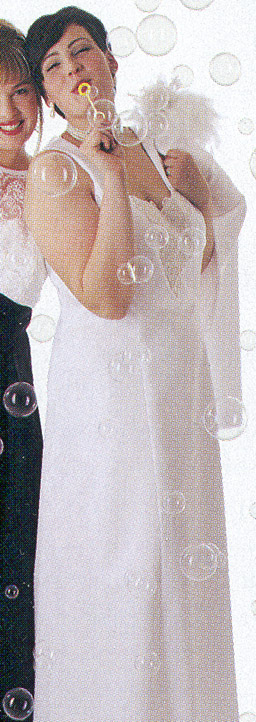
Since sending me this comment, Taylor has gone on to achieve some measure of success in her career, including notable editorial work and a television commercial. You may visit her Web site at: www.plusmodels.com/Taylor, or see a fine image from her Brides shoot here.
Congratulations! Your Web site has been chosen as a July 1999 winner of the Bella Online Magazine Web Design Award. This award is given to outstanding Web sites which address issues of concern to fuller-figured women and those who love them. Thank you for creating an exceptional Web site. Warm regards,
Lori Lewis
Editor/Publisher
Bella Online Magazine — BellaEzine@aol.com (1999.07.02)
I am truly honoured to have won this award. Bella is a top-notch electronic magazine devoted to full-figured femininity, and impresses me greatly by its focus on aesthetics over politics. The title of one of its contributor's articles sums up the tone of the magazine in general: “I am so f---ing beautiful!” I am even willing to tolerate the profanity of this statement for the sake of the welcome pride in one's appearance that it so vividly implies.
[Selection: Tomi] This was difficult! They're all so gorgeous and inspiring (in that I, too, am a “plus-size beauty”), and it is so refreshing to see women, for once, instead of boyish girls. My husband and even my six-year-old son comment on the unnaturalness and unattractiveness of the so-called normal-sized models and actresses.
Perhaps [the media resists plus-size beauty] to keep women “in our place.” If women continuously diet and exercise just to conform to the media's standards of attractiveness, they won't have any energy left to write that brilliant book or discover a cure for cancer. Just think about it, though. Think about all the energy and time that's wasted on trying to conform to societal norms of prettiness. To me, that's synonymous with mediocrity. And pathetic.
Lisette — lisettebc@whale-mail.com (1999.07.10)
Well said. However, like a previous responder, you overshoot the mark by saying that wasting one's time on something as stupid as weight control prevents women from writing a book or curing cancer. True, it does in fact have that effect, but the real crime is that it takes up women's time from doing anything else—not just such “grand” things, but anything else at all. The weight-control industry has less to do with keeping women “in their place” than with making women's lives miserable, in whatever place they are. And not to beat a dead horse, but let's remember always to ask ourselves who benefits from making women miserable, whatever their lot in life. The answer is institutional feminism, of course, which is invariably the leading culprit in these matters.
I seriously don't know [why the media resists plus-size beauty]! It's definitely ridiculous, though. There are thousands of different bodies, so why should the only “fashionable one” be the six-foot, ninety-pounds type? We ought to realize that there are several other types of silhouettes that are beautiful!
Tulipe — (1999.07.20)
I agree, except your comment suggests that a six-foot, ninety-pound woman can have a beautiful silhouette, and frankly, this is quite unlikely. I don't mean to say that being thin makes it impossible for a woman to be attractive, but it is a difficult hurdle to overcome. The pronounced femininity of a fuller figure provides an insurmountable advantage when it comes to comparing the beauty of one silhouette to another, and an underweight woman must have nothing less than the face of an angel even to be noticed alongside her better-endowed peers.
[The media resists plus-size beauty] because there is no money to be made from women that are perfectly happy with the way they look. So, the marketers set up an unrealistic ideal that women spend millions trying to achieve.
Heather Bartlett — goddess@nothinbutnet.org (1999.07.21)
You have correctly identified the marketing rationale behind making women hate their natural figures, but I think you may be wrong in your assumption that profits can only be made through this negative influence. In fact, much more profit can be made from the opposite approach—by acknowledging the superior beauty of the fuller figure. It would just yield a different kind of profit. Just consider all of the plus-size women who would buy sexier, more expensive clothes, and go out more often, if the media presented images of fuller-figured women partaking in such activities.
[The media resists plus-size beauty ] because larger people (especially women) are the last group that it is “safe” to criticize.
Rebecca — rebeccazbezinski@home.com (1999.07.26)
True, the media promotes criticism of larger women, but they are not quite the “last group” that earns criticism. One hallmark of the media has always been their eagerness to tear down anything that is lofty, to debunk all that is great and noble. If one considers the way, for example, kings and royalty are generally portrayed in the media, or the upper classes, or famous artists and composers, we see a consistent pattern of criticism and disparagement. To the media, anything that is truly extraordinary and superlative is treated with suspicion at very least. Moreover, anything that was the dominant taste or fashion of ages past earns their particular contempt. The same is true for plus-size beauty. Since the degree of media scorn rises in direct proportion to the true greatness of the target, the fact that the media attacks fuller-figured women so consistently, with such inexhaustible reserves of scorn and hostility, is itself the clearest testament to the power of plus-size beauty—a power so great that the media fears it, and feels it must never cease to suppress it.
[Selection: Kate Dillon] I think all the women are very pretty, but you forgot Mia Tyler. She is one of the prettiest plus-size models and a role model for many young ladies.
Anonymous (1999.07.27)
[The media resists plus-size beauty because] a lot of people think only the outside counts. But this can be turned to one's advantage. By dressing well when you have a few extra pounds, you can look better than anyone who is thin.
Christine — christinekeating@hotmail.com (1999.07.29)
Let's have a big round of applause for Christine. She has acknowledged a truth that many people—even those involved in the “size-acceptance movement”—still have a difficult time admitting: that plus-size beauty is superior to minus-size beauty, in every measurable way. The bottom line is that, no matter how innately attractive she may be, a beautiful-but-thin woman can never be as attractive as a beautiful, voluptuous woman.
[Selection: Sophie Dahl] [Members of the media resists plus-size beauty because] they were not born with the capability to have full bodies. They are naturally thin and resent the fact that we are healthy and beautiful, and they can never look like us.
Taylor — secretgiri@aol.com (1999.08.04)
Taylor's brief response is just as perceptive as Christine's (above). It's good to see that some girls are finally seeing through the stream of media brainwashing by which they are ceaselessly bombarded. It is an inescapable fact that much of the popular hostility to plus-size beauty stems directly from the naked resentment that most underweight women feel towards their more feminine, fuller-figured sisters. The psychology here is obvious: “Why,” the thin woman continually asks herself about her fuller-figured rival, “can she relax and be happy and indulge herself as much as she wants, and still earn all the attention, while I torture myself with diet and exercise, and never get noticed?” Many underweight women spend their whole careers in the media attempting to refashion the world as if the opposite were true, but to no avail, because the experience of real life always confounds their fictions.
[Selection: Kate Dillon] I love this woman!
Steve West — dirtystv@msn.com (1999.08.05)
[Selection: Ariana] I believe that society as a whole is becoming much more tolerant in the last few years, due to the increase in plus-size women in the media. In the '60s, there was Twiggy, a supermodel who, like Kate Moss, was horribly thin, and people started to look at women in that artificial light. In the '80s, everyone was “getting physical,” and people criticized anyone who didn't join the bandwagon. Now people are starting to see that luxury is all right, and society is returning to the sexy, voluptuous look, instead of the heroin-chic waif.
Debi Hodges — HeavenLeigh@heavenleigh.com (1999.08.05)
Absolutely! If I have a quibble with your response, however, it is that you attribute this change in society's perceptions to an increase in its level of tolerance, whereas in fact the opposite is true: society is simply becoming tired of the decades-old lie than thinness is attractive, and can no longer tolerate such an obvious fabrication.
[Selection: Sara Morrison] Sara looks like a china doll with that snowy-white complexion.
Diane C. Kuncken — dkuncken@aol.com (1999.08.12)
[Selection: Kate Dillon] I absolutely love Kate Dillon and am so glad to see her nominated with (of all things) a quote from my favourite book of all time!
Erika — bogartfan9@aol.com (1999.08.15)
Although somewhat marred by its vague commitment to feminist ideals, Kate Chopin's The Awakening is nevertheless a fine novel. The supporting character Adèle Ratignolle is one of the most exciting and desirable characters every created, and although the author skews the book in favour of a different, underweight protagonist, said protagonist always pays homage to her more generously-endowed friend's sensuous beauty, and far from wishing to demean her, she expresses nothing but the most fitting reverence for her.
[Selection: Liis] This woman is stunning. And the best thing is, she looks just like my girlfriend.
Kevin Guillory — suprfanboy@hotmail.com (1999.08.25)
[Selection: Kate Dillon] Kate Dillon is by far the most gorgeous woman on the face of the planet. *Sigh* I'm actually putting up a fan site for her in the next few days. It will be at: www.eskimo.com/~allegro/private/celebs.htm#Kate Dillon.
Anonymous (1999.08.31)
[Selection: Kate Dillon] I've been a MODE magazine reader for a while, and I have always wondered who that incredibly beautiful redhead was. Now I know! Long live Kate!
Dawn McKiness — Dont_Cry_Axl@yahoo.com (1999.09.12)
[Selection: Barbara Brickner] I am a plus-size model represented in New York City by Ford 12+. I think you should know that these models are not the top models in the industry. You left out the very busy Angellica [sic], Shannon Larkin, and Sarah Patterson.
Anonymous (1999.09.17)
For once, I am inclined to believe that this response came from a real model (spelling mistake notwithstanding). The tone of the message, which has been abbreviated here, was sufficiently brusque, and the nature of her comments sufficiently uncharitable. What she fails to realize is that the intention of this page was never to present the “top models” in the industry. If it were, it would not be showcasing plus models at all, but the likes of Claudia Schiffer. This page exhibits the most beautiful plus-size models according to classical standards of attractiveness. The latter two models whom the responder mentions do not qualify. Angellika is a more viable candidate, but not quite in the same league as other plus-size models from a purely objective, aesthetic point of view. And no model will be included here merely for political reasons of inclusiveness.
[Selection: Kate Dillon] Fresh. Unassuming. Classic. Innocent. “American.”
Tammara Rhone — tammara@earthlink.net (1999.09.17)
[Selection: Emme] I think these women are all very beautiful. If I had to pick one, it would be Emme, with Kate Dillon as a runner up, and then Liis.
Lisa — lazenby99@home.com (1999.09.25)
[Selection: Ariana] The models are all quite beautiful, and I am glad that plus-sized women are able to achieve the dream of modelling.
Leslie Drees — abnormal_3@hotmail.com (1999.10.17)
[Selection: Barbara Brickner] My beautiful sister, Barbara! Who is more wonderful than she?
pbrickner@marathon.net (1999.11.05)
[Selection: Kate Dillon] While every woman on this page is definitely very beautiful, Kate Dillon is absolutely exquisite. As an artist, I never tire of painting her. Her beauty is inspiration itself!
Jeffrey Harris — artist67@hotmail.com (1999.11.10)
[Selection: Barbara Brickner] All the women look beautiful beyond belief. But for the fullest figure and prettiest features, Barbara takes the title.
Anonymous (1999.11.29)
“Fullest figure” might be an honour that belongs to Sara Morrison, but as for Mrs. Brickner's having the “prettiest features,” it is difficult to disagree.
[Selection: Barbara Brickner] Hey, just look at Barbara Brickner! She is so stunning, she alone will change the way the media look at these beautiful, plus-size, absolutely gorgeous women. Thank you for your wonderful Web site!
“BBW Admirer” (1999.12.01)
Your Web site was nominated for and has been chosen to receive the Size Wise Excellence Award. This award honours size-positive sites and their owners. To be considered, a site must express respect for people of all sizes…[and] spread the word that nobody should wait until they have lost weight to enjoy all that life has to offer. Congratulations on a terrific job at creating and maintaining your site. It looks great and provides another size-positive on-line presence. Best regards,
Judy Sullivan
Author, Size Wise — www.sizewise.com (1999.12.01)
I am always honoured to receive awards of such distinction, and I encourage every viewer to visit Judy Sullivan's Web site, which is one of the most valuable size-positive resources on the Internet.
[Selection: Barbara Brickner] Barbara is absolutely gorgeous, as are the rest of the women on your page. I have always admired the fuller figure and am so glad that you have a site that showcases such beautiful women in all their glory. I hope the modelling world gets its act together and lets these women dominate the runways.
Anonymous (1999.12.01)
[Selection: Kate Dillon] There can be no choice other than Kate. The other women are stunning, beautiful ladies. Kate is a goddess!
Dan C (1999.12.03)
[Selection: Emme] It's Emme! Of course it's Emme!! It's always been Emme!!!
Anonymous (1999.12.03)
I try to refrain from posting anonymous comments, but who can resist such enthusiasm?
Hello! Let me introduce myself first. My name is Martin Wolff. I am a great fan of your Web page, and I have to say that I've hardly ever seen such an honest and serious page about plus-size, or as I like to call them, “real-size” women, featuring famous models like Emme and Sophie Dahl. Great work. Please go on in this style. I have tried to find information about some of the other models on your site, like Barbara Brickner, but could find very little. She is one of the finest, most amazing models I've ever seen. Does she have a home page? Do you know of any other links related to her? Sorry for the many questions, but I've been very excited since I discovered your pages in the wide streams of the Web.
Martin Wolff — wolf2410@hotmail.com (1999.12.07)
It is truly rewarding to hear such enthusiasm from a visitor to this Web page. I am sure that my investigation of Web links related to Mrs. Brickner has not been as thorough as yours, so I can introduce you to no other resources devoted to her. What I always encourage any viewers who acquire an interest in one of the models pictured here to do, if they don't find a Web page devoted to the objects of their affections, is to create one. It isn't that difficult. HTML is a baby-simple language, and there are many freely-accessible Web links where one can learn its fundamentals in no time at all. The best destiny of the Internet is its power to expose the opinions of individuals whose tastes fly in the face of “media culture,” that artificially-created entity which otherwise surrounds us. A Barbara Brickner Web site is an exciting prospect…
My name is Robert Griffith. I recently came across your page while looking for BBW- and weight-associated Web sites to which to link my own page. My Web site is for “above-average-sized” people, and hence its name is “Above Average.” It may be found at www.aboveaverage.org. I am writing to you because I would like to place a link to your Web site on my page. I hope you don't mind. Thank you for providing a site for those of us who are “above average.” Thanks for your time!
Robert Griffith — griff@pacific.net (1999.12.24)
You're welcome, and thank you for the link. I enjoy your site very much—especially the name, with its connotation of superiority, because plus-size beauty certainly is far superior to the average standard of beauty.
[Selection: Liis] This is a great page. These girls are Hella beautiful.
David — DWSwift@Earthlink.net (1999.12.25)
I agree…I think. What does “hella” mean?
[Selection: Sara Morrison] Plus-size modelling is simply an extension of the media's and fashion industry's subjugation of persons who are anything but a size 2. These women are not plus sized. They are explicitly average. Magazines like MODE only serve to uphold the stigma and prejudice of our society by claiming to represent plus-size women, but trying to convince us that size 8 represents something beyond normal. Real plus-size women are only made to feel more out of touch. The gap between many plus-sized women and plus-sized models is even larger than the gap between average women and your average supermodel. These are all beautiful women, but as I prefer plus-sized women, I cannot say that any of them are the most beautiful in the world. That title belongs to some woman who will never be allowed to grace the pages of MODE, someone shunned from plus-sized modelling for the sin of being fat.
Anonymous (1999.12.25)
Eloquently stated, and I must say that I am in complete agreement with you—even with your belief that the most beautiful woman in the world would be fuller figured than any of the models on this site. However, I dispute what you say about MODE. On this topic, please read what Simone Magnus had to say last year. MODE magazine is indisputably a step in the right direction, because it manages to be both populist, and defiant of media conventions. By showing women larger than the media standard in attractive poses and lovely apparel, MODE quietly subverts the idea that there is one, single standard of beauty—i.e., the one put forth by every other fashion magazine. It expands the perspective of readers who might otherwise uncritically swallow media brainwashing, not only in terms of aesthetics, but other issues as well. Once a reader rejects the media's standards of beauty, and sees how artificially constructed they are, compared with the natural human standards that have prevailed throughout the history of the West, that reader can then make the same imaginative leap about other issues as well. Ethics; prevailing political opinions; popular morality—all of these “self-evident truths” then stand revealed as nothing but the carefully calculated fictions of a select few.
If you see MODE as too moderate in terms of the size of the models it features, then by all means, do whatever you can to help create a popular magazine for real plus-size women. And don't doubt that I will stand in line to buy the first copy.
[Selection: Lorna Roberts] Difficult choice! This site definitely features the most beautiful women in the world!
rubens_29@hotmail.com (1999.12.26)
[Selection: Shannon Marie] I've been a fan of your wonderful site for a long time, and I hadn't visited for a while, and was pleasantly surprised to find a new face! I've always been partial to Kate Dillon, but I also can't resist the charms of the beautiful Shannon Marie. I send your URL to my friends constantly, to tell them where they can find true beauty. Keep up the good work!
Frank (1999.12.29)
[The media resists plus-size beauty because] cultures ebb and flow with time. Every other generation balances out the last. A hundred years ago women put on weight to look beautiful. Now, they get skinny.
Mathias — mathiasgreen@worldnet.att.net (1999.12.29)
Briefly, I must point out that your hypothesis is off, as most of the material on this site reveals. Women put on weight to be beautiful not only one hundred years ago, but in every age prior to this one. Plus-size beauty is real, natural, genuine, timeless beauty. Thinness is only an artificial construct of the century that is finally coming to an end right now. Consider the case of ex-goddess Carnie Wilson, who recently embarked on a regrettable and genuinely dangerous method of weight reduction. Yet not only was she still gorgeous before this weight loss, but the “after” images that have been broadcast in the media since her surgery reveal that she has lost most of her beauty along with her weight.
[Selection: Shannon Marie] This is a great Web site! Shannon Marie is very beautiful. I would love to see her in a bathing suit.
Navigator — net_navigator@hotmail.com (2000.01.10)
I can't blame you. That's why I still endorse the idea of a plus-size swimsuit calendar, or better yet, a swimsuit edition of MODE.
[Selection: Emme] I love Emme!
Ample Threads — phatrags@innernet.net (2000.01.11)
[Selection: Shannon Marie] It was a tough choice between Barbara Brickner and Shannon Marie. They are both beautiful.
Sarah — cheesegirl@hotmail.com (2000.01.12)
[Selection: Liis] I noticed that there are no Black Plus Models [on your site]. I know that they are out there because I was one of the top Black Plus Models in the industry between 1993 and 1998. I also modelled for Plus Figure Models and am a good fried of Liis. Perhaps you should branch off into more of a well-rounded Web site that includes other ethnicities. Ethnic models are out there, and they are just as beautiful.
Anonymous (2000.01.12)
This is one of those cases in which I am not prepared to discount the contributor's claims to be a model, or a former model. I am eager to include black plus-size models, but have yet to come across someone who fits the bill. (Angellika cannot win by default, and I will not include someone just to meet a quota.) I have almost been tempted to include a celebrity such as Queen Latifah or Star Jones, but that would be a different Web site altogether. (Say, does anyone want to build a Web tribute to plus-size actresses? It's badly needed!)
[Selection: Shannon Marie] It was a tough call, but I had to go with Shannon because I like her style.
Charlyne White — sharona@kltymail.com (2000.01.24)
[Selection: Kate Dillon] Wow!
wurz@canoemail.com (2000.01.27)
Hello! I wanted to take the time to thank you for putting together such a wonderful Web site dedicated to beautiful full-figured women. I have already “bookmarked” your site. I have explored several other sites and I love how intelligently yours is put together—the quotations are wonderful, and the links are much appreciated! My only question for you is, how did you find all of this information about these beautiful women? I would love to learn more about plus-size models (I love how “normal” they make me feel when I read MODE), but, other than your Web site, I have no idea where to look. I had no idea there even were plus-size models in Europe!
Thank you so much for all of the time and dedication that it must have taken to make your site as wonderful as it is. I am sure that I speak for many other women and girls when I say that it has definitely made me feel more desirable. I will be sure to visit frequently. Sincerely,
Mianna Arrington — miangels@hotmail.com (2000.01.29)
You cannot know how gratifying it is to receive a comment such as yours. Yes, putting the site together took an inordinate amount of time, and if anyone is wondering about the dearth of recent updates, let me say that completing my Masters degree takes precedence! As for the facts that I collate about the models, I largely use Internet search engines and whatever tidbits of information magazines such as MODE provide.
[Selection: Kate Dillon] Kate Dillon is my role model. She inspires me and gives me motivation.
Stephanie Chavira — cartman69_1975@yahoo.com (2000.02.01)
[Selection: Kate Dillon] Oh my God, they're all gorgeous, but I just saw Kate Dillon on the new MODE cover and I'm in love!
Dan — zencatt@aol.com (2000.02.05)
And who can blame you? Miss Dillon's March 2000 cover rivals Barbara Brickner's December 1999 showing as MODE's all-time greatest. Deciding which of the two is the superior image is about as difficult as deciding which of the two models is prettier. Without a doubt, the covers emphasize each model's respective strengths. If MODE showcased covers like this more often, it would fly off the periodical racks at twice the rate of any of the “waif” magazines. How could any Cosmo cover girl compare?
[Selection: Shannon Marie] These are all very beautiful women, but Shannon Marie really stood out to me. This is an excellent Web site. I love the pairing of modern beauties with classical art and literature.
Anonymous (2000.02.05)
[Selection: Barbara Brickner] I love the literary quotations, but let's hear from the ladies themselves.
Cjharon's Aide — saladoil62@aol.com (2000.02.05)
Your idea is wonderful, and if I had any more of the models' own comments at my disposal, I would certainly include them. If you, or any reader, chances upon what you consider to be statements worth preserving, by all means please forward them to me.
[Selection: Kate Dillon] All the women are very beautiful
Sandra — babyvixen@webmail.bellsouth.net (2000.02.05)
Hello. Does Liis have an e-mail address? I ask because I also live in Toronto, and am single, successful, 30, and handsome, and would love to chat with Liis on the off-chance that she is also single. Thank you for your attention.
J**** B******** — ********@******.com (2000.02.06)
This is the sort of comment that I do not wish to receive. Even if I did have Liis's e-mail address (and, of course, I do not), do you think that I would ever give it out publicly? And I sincerely doubt that Liis is hard up for male companionship.
Hi. First, I would like to say that your site is great. Second, I saw the pics of Shannon Marie and was wondering whether you have any additional information about her, or if you knew where I might find some additional pictures of her. Thanks.
Dave — dj130@hotmail.com (2000.02.06)
Alas, I know no more about Shannon Marie than you do, and if I knew of any other pictures of her, I would certainly nick them for my Web page.
[The media resists plus-size beauty] because it is in a state of collective denial. It may also be afraid to admit our love of curvaceous ladies because of the so-called “societal” standards that they, in fact, created. However, these things are changing, and I believe very quickly.
kdm1@netscape.net (2000.02.08)
It's true. Consider the uproar caused by the recent Bijan advertisements featuring a gorgeous and very full-figured model named “Bella.” At first, the major periodicals refused to run the ads, but when one editor finally gave in, the other magazines followed suit within days—for fear of being “left behind.” Herd mentality permeates the media. They all stand still as long as they can, but if one member of the herd moves, a stampede soon follows. Now, if we can only use this characteristic of the media to our advantage…
[Selection: Shannon Marie] Two words: Natalie Laughlin.
David — dburns2@earthlink.net (2000.02.13)
Three words: What about her?
Dear HSG: I just discovered your home page and I definitely agree with you! I will be sure to make many others aware of it. I am a “timeless woman” myself and have a number of friends who are as well. We are all very proud of our voluptuous beauty. Keep up the good work!
Brenda (Ontario, Canada) — lewnmole@sentex.net (2000.02.13)
Thank you for your approval. As the Greeks taught us, pride is the greatest virtue, and the sooner women follow your example and learn to delight in their appearance and free themselves of the tyranny of “weight control,” the sooner society's standards will change.
[Selection: Selection: Kate Dillon] Though Kate Dillon is one of the most beautiful women on Earth, I do with that I could also have voted for Mia Tyler.
Aaron Granda — throcmtn@aol.com (2000.02.15)
Very interesting and beautifully done! You might help people to one day realize that beauty comes in many different forms.
Lisa — lisasellsavon@yahoo.com (2000.02.15)
I sincerely hope so, and I hope that “one day” comes soon. Consider the recent Cacique lingerie ad campaign sponsored by Lane Bryant, featuring the buxom Anna Nicole Smith, among others. A few years ago, who would have dreamed of putting on a show like this? If anyone had, it would have been totally ignored, and no actress, whatever her size, would have been caught dead associating with it. But this show was a major media event, and received sensational press. Change is coming, and it isn't coming next month, or next week but tomorrow…today…right now!
[Selection: Lorna Roberts] It was so hard to choose because they are all beautiful and have inspired me to pursue this career.
Melissa Hollingsworth — mholly99@hotmail.com (2000.02.16)
[Selection: Kate Dillon] Kate Dillon is truly amazing. Every time I see her, I am just blown away by her beauty!
Julianna (2000.02.17)
[The media resists plus-size beauty] because thin women and female children combined create one huge merchandise market. The media may also be the pawns of spiritual dominions who inspired the one-size combo. The consolidated woman-child target is then expeditiously marked for corruption.
Anonymous (2000.02.18)
Though anonymous, this response was strange enough that I simply had to post it. I would love to know what this commentator means by “spiritual dominions,” but as far as the market goes, 60% of women in the United States wear a size 12 or larger, so there is something other than mere capitalism at fault here. Indeed, if the market were deciding the matter, plus-size fashion would be in a position of virtual monopoly, and the fact that this isn't the case suggests a very different source of resistance (except, of course, as concerns the obscene weight-loss industry).
These woman are truly beautiful. They represent real beauty. I am a male model myself and I work with stick insects every day. Some of them make me sick. I find drugs, anorexia, bulimia, etc. a real turnoff. These women are stunning. They take my breath away.
Trent F. (2000.02.19)
I am always suspicious when someone of either gender writes in and announces himself as a model. However, if “Trent” really is what he says he is, then who can blame him for his exasperation? He would see the results of perverse attempts at “weight control” every day. Small wonder, then, that images of plus-size models are like a breath of fresh air to him.
I don't know if it's a cliché to say so, but the media today is bent on suppressing what is natural in women. There is misogyny at the heart of this, because the media, in general, sees voluptuousness as a display of “power,” and so the idea was conceived among them that in order to suppress this, they would “make the waif ‘in.'” It is easier to control women and objectify them when they are “clothes racks” than when they are goddesses. I believe that men generally feel inferior to women because of their awareness of the power of feminine beauty. So the idea is to minimize this power by advertising that women are more attractive when they look less feminine.
Another reason why plus-size beauty encounters resistance is because the media is too proud to see its empire of “skinniness=attractiveness” tumbled after all this time by an “old” aesthetic, one that is far more attractive in reality.
Chris Tadina — agroskunk@netzero.net (2000.02.22)
This is a truly insightful response that comes very near the heart of the matter. The real target of the media today is not simply women in general, but a specific idea of women, and it is not merely men that are responsible for this, but both men and women of a certain political leaning. You are absolutely correct to say that femininity, and “what is natural in women,” is the real target of their attack, and that feminine beauty is considered “dangerous.” If women are coerced into becoming weak, self-conscious, androgynous robots without any identity except as part of a feminist collective, then they indeed become powerless, and very easy to manipulate. But if they follow their natural feminine impulses and revel in food and beauty and life, if they look in their mirrors and feel their own power as individual goddesses, able to think and feel and eat whatever they want, then where does that leave the ideologues who would make feminist puppets out of them? Nowhere.
The “waif” look is not just unattractive, but unnatural—an unnatural ideal created by the proponents of unnatural systems of human society. But take heart. The woman will triumph over the waif, and femininity will defeat feminism, very soon.
Hello. I agree that Liis is beautiful. Does she have an e-mail/fan-mail address?
Jason (2000.02.24)
I know of no such address for Liis personally, but anyone wishing to send her fan mail may wish to write to Liis care of the modelling agency that represents her:
[Selection: Barbara Brickner] The media says that “thin is in,” but I must disagree strongly. I am a single American male in my thirties, and I have not met anyone, and I mean anyone, who thinks that thin is attractive. You see all these images on television, in print, and on the silver screen, of women who all look pencil thin and unhealthy. They are all made from a cookie cutter—they all look the same, and it really is pathetic. As for the models on this site, they are all very attractive. It's good to see “real” women hopefully showing the media that “thin is out,” and that “natural” women are in!
Anonymous (2000.02.25)
I hate posting anonymous responses, but there is much to what this person says. The actresses and models whom we see in the media do look as if they were manufactured on an assembly line—their figures, and sometimes even their facial features, seem identical—and whenever anyone appears who doesn't fit the mold, she is criticized on precisely that basis. It is an impulse towards lamentable sameness, and what makes it even worse is that the “look” that media personalities pursue is such an unattractive one to begin with. By emulating each other, they end up merely looking identically unattractive. By contrast, plus-size models are unique. They have different body types, their faces are readily distinguishable, and, if there is a common feature among them, it is that they all have gorgeous figures.Naturally, this relates to a much larger issue—i.e., the modern world's suppression of beauty in every form. Someone seeking to distinguish the twentieth century from earlier eras could well term it “the century of ugliness,” because, for reasons that demand careful examination, beauty in all its manifestations has been rejected in this century, and ugliness enshrined as a kind of perverted ideal, both in form and in content. Today, we are still the inheritors of this (anti-)aesthetic legacy.
Who can survey the abominations that we celebrate as “masterpieces” in our time, and not wish to return to the values of an earlier, aesthetically healthier age? Who can listen to the atonal cacophony of Anton von Webern, and not yearn for the sublime strains of Beethoven? Who can read the self-consciously formless gibberish of Gertrude Stein, and not reach out for the bracing Dark Romantic poetry of Lord Byron? Who can stare at the bedlam paintings of Jackson Pollock, and not long for the Prussian passion of Caspar David Friedrich? Who can gaze at the post-Bauhaus glass boxes that choke North American city centres, and not pine for the days of castles, and cathedrals, and Historicist design?
And who, following this same line of thinking, can look at the asexual figures and androgynous features of today's media celebrities, and not seek the rebirth of cultures whose paragons of loveliness were the opulent goddesses of Titian, and Rubens, and Renoir?
These matters are all inextricably interwoven. The same forces that venerate ugliness in art venerate ugliness in female aesthetics. For the latter to be overturned, decades of brainwashing by the proponents of “ugliness chic” have to be erased. But signs of renewal are slowly appearing (e.g., the popularity of Romantic and Victorian painting is booming), and MODE is certainly doing its share. Every plus-size model who “makes it” represents a one-woman aesthetic revolution, and MODE can well be considered the inaugural magazine of the twenty-first century.
[Selection: Kate Dillon] Kate Dillon is the most beautiful and sexiest model I have ever seen. Everything about her kicks ass! Her face is awesome.
Mike Mueller — mike_mueller21@hotmail.com (2000.02.29)
I delight in receiving youthful responses such as this. I hope that while his friends are pasting photos of starving models (with pathetically pretty faces) like Bridget Hall on their lockers, young Mr. Mueller proudly puts up a picture of the glorious Miss Dillon in his, to show his friends what real beauty looks like. (Tip for Mike: don't miss Kate's long-awaited swimsuit photo, in the April 2000 issue of MODE.)
[Selection: Kate Dillon] I think you guys [sic] miss Mia Tyler. Yes, Steven Tyler's little girl and Liv Tyler's little sister. She's beautiful.
Elsota — elsita@hotmail.com (2000.03.02)
[Selection: Kate Dillon] Although each of these models is close to the epitome of beauty, it's only Kate Dillon that can be sexy, flirtatious, fun, and sultry, all in one. It's a stroke of luck to us all that this incredible-looking woman shows up on the pages of magazines!
Joe_strongside@yahoo.com (2000.03.06)
[The media resists plus-size beauty] because Western society is ascetic—if it's not contained and controlled, it's considered overindulgent and weak. Women who are “too” anything—plump, large, boisterous, smart, honest, lively—are all considered “out of control” and dangerous. If women weren't obsessed with their weight, their energies would be aimed elsewhere—and that would upset the status quo. That, of course, is unacceptable. Tragic.
Michele Blue — michele_blue@yahoo.com (2000.03.07)
Simone Magnus wrote a fine commentary on this topic, and I have posted it on my “Lydian MODE” page. And you are exactly correct—“weight control” is part of the code of conduct of meekness and humility to which we expect women in our culture to adhere, in order to contain them and restrict them. Even our terminology indicates this—“overinduglence,” for example. What does that word actually mean? Too much induglence? Why, in all seriousness, should there be any limit on indulgence? If a beautiful young woman wants to indulge in an extra dessert, why should she deny herself this pleasure? Appetite is an entirely natural sensation. Why should it be artificially impeded?
Or consider the question that is sometimes asked of a woman who has allowed her figure to develop feminine proportions: “Have you been letting yourself go?” How can that in any way be negative? To “let someone go” means to liberate them, to free them from some manner of bondage; therefore, to “let yourself go” is to liberate yourself—to free yourself of anyone who would tell you what to think, or what to eat, or how much pleasure to have.
To be free, you should “let yourself go” at every opportunity. What kind of life does a woman lead who always contains her desires, and denies her cravings, and controls her appetites? What kind of life, but a life of confinement—a joyless, self-imposed prison? And what has she done to deserve this? Nothing. Why sentence yourself this way? Why imprison yourself with diet, and gruelling exercise regimens? Life is too short to waste a single minute of it incarcerated. Remember these two rules for happiness:
What a fantastic site. I especially enjoyed the “Timeless Beauty” section, and the re-posting of Simone's contributions to MODE. As a MODE fanatic myself, I can only say that I agree with just about everything that Simone says—we plus-size women don't want to see ourselves as occasionally-attractive exceptions to some beautiful rule; we want to be the beautiful rule.
All the women in your various sections are healthy, radiant, alive. In a world where voluptuous women are supposed to be penitent, quiet, and, above all, ashamed, these models are defiantly proud. There was one trend that I picked up among all the historic women that you chose—they were loved, they were unashamed, they were inspirational. Kudos to MODE women historic and current, and to you for the excellent presentation.
Susan Carlson — smcarl@ibm.net (2000.03.07)
You have no idea how rewarding it is to receive a comment such as this. Susan Carlson has a profound understanding of both the intent and the technique of this Web site, and when the tyranny of “ugliness chic” is finally topplied, it will be because of people like her.
The problem with the “size acceptance” movement has always been its apologetic tone. How sad it was to watch a recent Entertainment Tonight special on Designing Women, and see an interview that Delta Burke made during the run of the show. She seemed so quiet, almost apologetic about her appearance—and this was at a time when she was at the very peak of her beauty! Watching it, I couldn't help but think how instead of meekly saying, “I'm not thin, but I'm still beautiful,” what she proudly should have been saying was “I'm more beautiful, because I'm not thin!” If only she, and women like her, could take their example from the goddesses of the past, who revelled in their appearance, who never denied themselves any pleasures—knowing that what they gained in weight, they gained in beauty—and who challenged the world to be worthy of them.
[Selection: Shannon Marie] Why has Mia Tyler been left off this list?
Bobby — sisko@mounet.com (2000.03.11)
Rest assured, all of you who have written in advocating Mia Tyler's candidacy for Paris's judgment. She will probably appear here very soon. In the meantime, if any of you have favourite images of Ms. Tyler that you would like to see on this site, please feel free to e-mail them to me…
[Selection: Shannon Marie] I love your site! What beautiful women. My favourite is Shannon Marie. Where can I read more about her, and see more pictures?
Kristine — Kristiane@kc.rr.com (2000.03.19)
Click here to read “Model Behaviour,” Alight.com's fascinating profile of Shannon Marie.
[Selection: Barbara Brickner] I believe that Natalie Laughlin should be a candidate in your Judgment of Paris competition. After all, it seems that she has been Wilhelmina's plus-size spokes-model for the past year and a half. I hope to see her here in the future.
Anonymous (2000.03.21)
[Selection: Kate Dillon] Every nominee is extraordinarily beautiful. Shannon Marie is a close second for me. She and Kate both look like the girl next door.
fairie1@earthlink.net (2000.03.22)
The girl next door? How extraordinary. If women like these are your neighbours, then I simply must move to your neighbourhood. :)
[Selection: Barbara Brickner] Natalie Laughlin also.
Roger Fortune — rgf15@columbia.edu (2000.03.26)
See above.
Honestly, I have no idea why [the media resists plus-size beauty]. It's amazing to me. My guess would be that the fashion industry always seems to depict the unattainable, therefore tragically depicting the perfect form as a sickly, malnourished ghost of a woman. It's appalling, and I fear for my own daughter, wondering if she will grow up thinking like I once thought, that the ideal is to resemble a Dickens waif. I hope I have instilled a stronger sense of self within her. My fear is that the media will crush that.
Anna — Tempestaari@aol.com (2000.03.27)
Anna's fears are well founded, because the power of the media in our society is overwhelming. Once, familial bonds were strong enough to counteract any influence that the media might have had on a young girl, but now, that is seldom the case.
What is much worse, however, is the appalling fact that mothers themselves are often complicit with the media in the destruction of their daughters' self-esteem. How abhorrent it is to see mothers who demean their daughters by implying that they may have “had enough” during a meal. Or worse, how sickening to see mothers who sentence their own daughters—whom they purport to love—to cruel ordeals of dieting and exercise. I do not care to speculate about what the psychological basis for such malicious behaviour may be—whether it is due to mothers' pathological attempts to retain control over their daughters, or stunt their blossoming into womanhood, or even a twisted resentment of their daughters' happiness (the “my mother made me diet, so I'll make her diet too” scenario).
I hope that there are more mothers like Anna, who teach their daughters to reject media brainwashing, and who love them enough never to starve them, or to belittle their appearance. I also hope that any young girl who does suffer appearance-related abuse at the hands of her mother finds the inner strength to stand up to her, to reject her mother's attempt to poison her body and mind, and to live in complete security of her own beauty and individuality.
[Selection: Kate Dillon] Kate Dillon is a true goddess.
Maria (2000.03.28)
Hello. I am a male anoretic and am currently dating a plus-size model—who is six feet tall. :) The shortages of the great depression brought with them idolization of women like Marilyn Monroe and Liz Taylor—real feminine beauty. I look forward to a time when a healthier America also looks up to a healthier standard; however, I think unhealthy people will continue to idolize unhealthy icons.
Jason — zaphraud@anorexia.org (2000.04.06)
Many look forward to such a time besides yourself. And the actresses you mention are, of course, excellent examples of naturally-proportioned beauty, and both were most desirable when they wore what are today considered “plus” sizes. Marilyn Monroe was never so irresistible as when she made the film Let's Make Love, at which time her dress size was a 16—at least. Elizabeth Taylor famously gained weight in the 1970s, yet not only did she remain attractive, but her looks took on a new and even lovelier quality of softness than they had ever had before. (Sadly, when Mrs. Taylor subsequently lost weight, she immediately appeared to age at least ten years.)
We need not restrict ourselves to America, either. In Germany during the '30s and '40s, the voluptuous Zarah Leander was the darling of the silver screen. Not surprisingly, this curvaceous goddess, who held parties at which she famously “ate enough for three,” has been all but forgotten. And so, when people ask, “Why are there no more Marilyns today?” the tragic answer is because actresses who have Marilyn-Monroe-like proportions have been discriminated against for decades. But this artificial “glass ceiling” for beauty will end—and sooner than many in Hollywood think!
[Selection: Emme] An American beauty.
Ashley — brownster@hotmail.com (2000.04.07)
[Selection: Kate Dillon] Shame on you for not including a woman of colour in your list of nominations! I love Kate Dillon and so she gets my vote but I would have liked to have seen a woman of colour; say, Angellika Morton, or Keicia Adzimah in your list.
nubiennelady@mciworld.com (2000.04.08)
[Selection: Kate Dillon] All the models are beautiful. It's hard to pick just one, but Kate Dillon is my favourite.
Alexxis [sic] Cortez — m1ss_sunshine@hotmail.com (2000.04.10)
[Selection: Kate Dillon] I would love to e-mail Kate Dillon. Please let me know if you can help. Thanks,
Mark Cinque — honeyjas@e-machines.net (2000.04.12)
Check out this Web site of another Canadian model: www.traciestern.com and please let me know what you think.
Matthew Sturm — matthewsturm@hotmail.com (2000.04.14)
Stunning. Absolutely stunning. Thank you ever so much for bringing Tracie Stern's Web site to my attention. I will be linking to it soon. Mrs. Stern has a remarkable look, especially in her more recent work. If I have a criticism, it is that she is a little on the thin side for a plus-size model, but her natural beauty more than makes up for that. I think the site is elegantly designed, too. Thanks again.
[Selection: Kate Dillon] Your picture does her (Kate Dillon) small justice, but she is a most beautiful creation, without doubt. And remember, Marilyn Monroe probably couldn't get work in today's Hollywood…But why no mention of the woman who really broke open the “large-size-model” ghetto—Anna Nicole Smith? She was the first modern model to go against the skinnies and make it with the “Guess?” campaign.
Anonymous (2000.04.17)
Point well taken. I have not been accustomed to thinking of Anna Nicole Smith as a model, since by the time she began to put on weight, she had abandoned the “Guess?” campaign for a movie career. However, I have learned that she first modelled for Lane Bryant several years ago, and then made a well-publicized reappearance at a recent fashion show in order to help them launch their Cacique line of plus-size lingerie—so her model credentials are solid. Moreover, many still believe that her famous appearance at the Oscars wearing a defiantly form-fitting red dress, with her hair elaborately arranged in a luxurious coiffure, and preening for the cameras as if she were the most beautiful woman in the world (and perhaps she was, that night) represents the ne plus ultra of plus-size fashion, the absolute perfection of opulent voluptuousness, a look that no woman under a size 14 could ever ever duplicate.
[Selection: Shannon Marie] Katie and Kate Dillon are also very beautiful.
Angela Talton — mperrottil@earthlink.net (2000.04.20)
Dear…
Since I don't know your name, I can't use it, but I was surfing and I came across your site via Liis's Web page. She is a good friend of mine, and it was very nice of you to take the time and effort to dedicate such images and words to her. I would like to take this opportunity to say thank you for your kind words on describing my site. They were very eloquent and much appreciated. Coming from a stranger, I couldn't ask for more. Thanks again. Sincerely,
Tracie Stern
[Selection: Barbara Brickner] As for adding a comment, judging these plus-size models goes against everything you all seem to be preaching about. Just as every woman is different and beautiful in her own way, each plus-size model offers something of her own to this industry. Each one has a message of personal experiences, each one has images of heartbreak after losing the greatest crush of her life to a cheerleader…to pick one woman in this business that is the most beautiful, well, looks is one way to do it, but I happen to know a lot of these women first hand, and I can honestly say that if push came to shove, they would all stand together to fight any issue that plagues women today. It is also not fair to judge a woman on her size. You criticize plus models for not being plus enough, but isn't this one of the issues that we are trying to overcome—not judging, just appreciating? There will come a day when there won't be such a category as plus-size models, just simply models that are a size 10 and up. (Sorry to break it to you, but in the industry, a size 10 is a plus!) Let's not segregate any longer. You are all beautiful, whether you have a big bust, big hips, cheekbones, or a booty that could stop traffic. The key to acceptance is to find your asset and work it, not to focus on the flaws. Thank you for your time.
Veronica (2000.04.26)
I do not know to whom Veronica's “you all” is supposed to refer, but I suspect that she came upon this site via a link from another page, and is reacting to statements made on that Web site as well as my own. I will nevertheless respond to her comments, one by one.
First of all, the act of judging does not go against anything that this Web site “preaches” (although I cannot speak for any other Internet resource devoted to this topic). These pages demonstrate that the full-figured ideal is not as beautiful as thinness, or equally beautiful with thinness, but more beautiful than thinness! This site reveals how plus-size beauty is demonstrably superior to the artificial, emaciated look that is promulgated by the media in our culture. That is indeed a judgment…and it is a sound one. It is based upon an application of the timeless ideals of beauty that held sway over Western aesthetics in every age prior to our own.
From this judgment, we next move toward judging between different embodiments of the ideal as incarnated in today's plus-size models. Not only are looks “one way to do it,” as Veronica acknowledges, but looks are the only way to do it. It is not the models' personalities that we are assessing, but their beauty. Undoubtedly, each of these women has a rewarding “message of personal experiences,” and surely they would all “stand together” on important issues, as Veronica says. Those things are commendable, but are not relevant here.
In fact, we should resist the impulse to focus so heavily on models' “personalities.” Why? Because if we don't, we merely repeat what our culture always says about fuller-figured women. How often do we hear those patronizing words, “she has a nice personality,” when a fuller-figured woman's merits are being extolled? Her “wonderful personality” become something we grant her, to compensate for her supposed physical shortcomings. We “make up” for her imaginary deficiency in beauty by conferring assets upon her that are not based on appearance. Thus, emphasizing that a model has a great personality is like giving her a “consolation prize” because she is not actually beautiful enough. We should instead say that it doesn't matter if plus-size models have nice personalities, because they need no such consolation! Why not judge a woman on her size, when the judgment is in her favour? If we avoid doing so, we merely perpetuates the myth that it is not.
Second, like many fans of MODE I do criticize some plus-size models for not being plus enough. The difference is that while others do so for moral reasons, I do so on aesthetic grounds. The moral argument goes as follows: “Plus models have become role models as well as fashion models, so they should be full-figured enough to dissuade young women from torturing themselves with ‘weight control'—and what kind of message does it send if Lane Bryant uses minus-size models to display clothing for plus-size teens?” I am in complete sympathy with this moral point of view. But my criticism is rooted in aesthetics. As my “Timeless Beauty” page demonstrates, the proportions of the Western ideal of feminine beauty have always been what we would now consider “full figured,” but which, in every century prior to our own, were always considered natural. A woman who is a size 10 or 12, while she may have attractive qualities (like pretty facial features) still falls short of that classical ideal.
Incidentally, what does it matter if, as Veronica says, “the industry” considers 10 a plus size? This is the same “industry” that brought us “anorexic chic”—literally, beauty that is no beauty at all—so it is quite discredited as an authority.
Finally, whereas Veronica is seeking mere acceptance, many visitors to this site want something more. They want celebration and adoration—and so they should. The point is not that women are beautiful whether they have a large bust, hips, cheekbones, etc.; but that they are beautiful because they have these generous proportions. They don't have to work to “find” their assets—these are their assets! These are not “flaws” to be overcome, but blessings for which to be thankful. Once we realize this, we will never need to become some sort of uncritical, mutual-appreciation society. (Who would want to live in a culture of such monotony, a culture in which we cannot admit that someone might be prettier, or smarter, or better skilled than someone else, and in which natural gifts cannot shine?) Rather, we will appreciate beauty when we see it, and venerate it without envy or resentment.
[Selection: Kate Dillon] Kate is the most beautiful woman I have ever seen.
Robert Maggard — rmaggard@fullnet.net (2000.05.03)
[Selection: Shannon Marie] Hard decision between Shannon Marie, Kate Dillon, and Barbara Brickner. Do I have to decide, or can marry all three? (Variety is God's greatest gift.)
[The media resists plus-size beauty] because they are f---ing idiots about everything!
Jim Young — singe_69@hotmail.com (2000.05.05)
I would ask Mr. Young to watch his language…except his frustration is quite understandable, and shared by many.
[Selection: Barbara Brickner] I was always a fan of Emme, but she has now been replaced.
CDMan (2000.05.09)
[Selection: Shannon Marie] Gorgeous.
V — frogfaerie@aol.com (2000.05.14)
I think that the media reflects our…society's last-ditch effort to make women feel insecure about the most personal part of their beings—their bodies. If a woman feels insecure about her body, her entire world is filtered through that discontent and shame. So in the end, the woman is paralyzed by self-doubt and not the full woman she could be…We can make a change every day, though, by not supporting companies that treat women of size as burdensome. We can unlearn what we were taught to be ashamed of, and create a new world for ourselves through loving ourselves first, and foremost, while we transform the world around us in our images!
Danielle — Eurowrite@hotmail.com (2000.05.15)
Danielle's plan of resistance is worth careful consideration, as is her theory that the media reflects a societal impulse. Let us follow her lead and ask ourselves, what element in society benefits from making women feel guilty about their femininity? What special-interest groups try to deny the significance of gender and ethnicity on human beings? Marxists, feminists, and left-wing activists, of course. In order to create a society of identical drones, their philosophy (“cultural materialism,” as they call it) makes the claim that men and women are identical, and only taught to become male and female by society at large.
Since even the most rudimentary biology disproves this—let alone every natural instinct that we ever feel throughout our lives—how (you might ask) can these ideologues expect anyone to believe their hallucination? If you are a socialist, how do you get people to buy into your fiction? Well, first you infiltrate the media and relentlessly discriminate in favour of a flat, sexless, ideal of womanhood. Then you bombard society with magazine covers and television programs, all of which reinforce this prepubescent image. Since feminine dress hangs badly on skeletal frames, you then justifiably dress your sexless models and actresses in masculine attire (like business suits), and crop their hair short, in order to make them look even more boyish. And if that isn't enough, you play up their faux-masculinity even further by encouraging them to take up pursuits like bodybuilding—no matter how unnatural it is for them to do so. And when all this is finished, what do you have? That's right—women disguised as men. Everywhere. And sure enough, it suddenly becomes a lot easier to pretend that there aren't any differences between genders.
But the fact that this propaganda is based on a patent lie is what will ultimately undo it. Nothing is as subversive of feminist ideology as women who glory in their ample, feminine curves. Such women by their physical existence disprove every theory of androgynous humanity, and reaffirm the laws of nature. Take turn-of-the-century actress Lillian Russell, for example. To play the part of a woman who temporarily disguises herself as a man, she was once required to don male attire. Nevertheless, one appreciative audience member said of her performance that he "had never seen anyone who looked less like a man in his life"! Not even Russell's professionalism and the magic of stage lighting could disguise her luxuriant femininity. Is it any wonder, then, that women with generous feminine figures are so threatening to the feminist project, and a force that they have worked so hard to eradicate?
I saw your tribute to Liis and I wanted to know if you are familiar with Angellika. Check out her pics on her brand new Web site—www.angellika.com—and prepare to be wowed! I guarantee you'll be impressed by her contribution to the new shape of fashion and beauty. Thank you.
Lindsay Gray — lindsayg@bellatlantic.net (2000.05.16)
[The media resists plus-size beauty because] thin, waif-like beauties are nonthreatening…It's no coincidence that the higher up the career ladder a woman climbs, the greater pressure she feels to maintain that societally-accepted thinness. Subconsciously, I think, it's a modern variant on foot-binding or tight-lacing. Women who deny their appetites, who are weak and compact, are kept subservient to the men alongside whom they work.
Anæsthesia (2000.05.19)
The self-contradictory nature of this response provides us with a fine example of the mendacity of feminist brainwashing, which not only oppresses women, but also covers its tracks by deviously shifting the blame for the misery that it engenders onto chimeras like “men” or “the patriarchy.” In truth, it is the female editors of magazines like Cosmopolitan and Vogue who have perpetuated and reinforced the androgynous ideal. It is not men, but women who have imposed this artificial standard on themselves.
As for the hypothetical example of the career woman, since she is climbing the corporate ladder, she is obviously not being “kept subservient” by anyone, and the pressure that she feels to conform to “societally-accepted thinness” arises not from her male co-workers, but from her own sad impulse to follow any trend in order to be a “player,” and to close the “next big deal.” Indeed, this “pressure” she feels probably reflects her own dissatisfaction at trying to adapt to an unnaturally competitive environment at the expense of her creativity, imagination, and the potential for a rich family life.
In light of the fact that Sophie Dahl is now a smaller size, perhaps you need to rethink her inclusion on your site. It seems she is rejecting her body to conform with today's vision of beauty, not yesterday's. Regards,
Pippa Jefferys — pippa@capwest.com (2000.05.29)
I have been critical of Sophie Dahl's weight loss ever since I created this site, and have considered removing her. However, at the peak of her beauty she was a more perfect embodiment of the classical ideal of femininity than any other plus-size model, before or since. (How fitting that the Unofficial Sophie Dahl Pages were created by a Greek Webmaster!) Furthermore, her recent appearance on the cover of British Marie Claire, in a special issue entirely devoted to plus-size fashion, indicates that her name is still synonymous with the advancement of an untimely standard of beauty.
Kate is really beautiful. I would like to get a hold of one of her posters. Are there any? How can I obtain one?
Rodel — Ferbilco@aol.com (2000.05.29)
Alas, I know of no posters showcasing the beauty of Kate Dillon, or that of any other fuller-figured model—not even Emme. If any marketing genius out there reads this, I strongly urge him to consider putting out a series of plus-size-model posters (or a calendar, perhaps). In fact, why doesn't MODE undertake this sort of venture? The revenue such a project would generate could be considerable, and nothing would be better than to see teenagers' closets around the country decorated with Liis's lovely face, rather than Cindy Crawford's.
[Selection: Liis] A beautiful and dark sensualness radiates from her eyes.
Fashion has much to do with [the media resistance to plus-size beauty]. Also…skinny women are more delicate…[and] men these days are intimidated—I know I am—by women who are strong and independent. Centuries ago, it was a man's job to take care of the woman, and some men have seen the thin, frail, runway waif as…a woman they could take care of and look after…A normal, healthy-sized woman may be a bit intimidating. Another theory is that the skinner the model, the less they'll have to pay for material to cover her bony frame.
Walt — killmanjack@hotmail.com (2000.05.31)
I'm laughing out loud at your joke. It's a good one. But the rest of your statement is misleading. An unfortunate new stereotype is starting to develop about fuller-figured women, even among those who purport to admire them—i.e., that they are always “independent,” and not as “delicate” as skinny women. This is absurd. A woman's strength is not based on how aggressive she is. (Consider the case of Lotte in Goethe's The Sorrows of Young Werther, whose power is based on her femininity, not her autonomy.)
Plus-size women can be every bit as feminine as their starving sisters—indeed, much more so. Physique can reflect character. Gauntness is stiff and cold and angular and unyielding, while voluptuousness is soft and warm and round and…yes, delicate. Furthermore, there is nothing wrong with a man taking care of a woman, if both enjoy the arrangement. A woman's strength is determined by the richness of her character, not by the timeliness of her values.
[The media resists plus-size beauty] because what passes for desire today is essentially without passion. It is simply covetousness, a form of dry and empty display alone. Actually loving a real woman brings any sane and sensitive man to the prompt realization that only the voluptuous is truly and completely beautiful to all the senses…We live in an age that lacks poetry, and these women are alexandrines walking the earth.
David Garon — dunver@iname.com (2000.06.06)
This response is elegant and profound. How right Mr. Garon is to say that we live in a prosaic age! Who can fail to admire the fervour and intensity exhibited by those who lived in bygone eras? And who can lament how passionless our lives are, by comparison?
The fate of poetry itself vividly illustrates this decline. For example, in the early 19th century, the great German Romantic poet Theodor Körner didn't merely talk about liberating his homeland from the Napoleonic yoke—he joined the Prussian army and fought for it. He even composed some of his greatest poetry right there on the battlefield, while his life's blood was draining away. Such passion was typical in his day and age, but in our time, it has all but vanished. What passes for poetry today is nothing more than journalism in free verse. No one writes about “the truths and verities of the heart,” as William Faulkner said in his address on receiving the Nobel Prize, but about trendy political causes. Is it any wonder that, in an age such as this, the preferred female aesthetic is a tepidly androgynous look?
In comparing plus-size models to alexandrines, Mr. Garon also makes a clever literary point. The standard English verse form used by Shakespeare, Milton, and all the great English poets is pentameter (five beats per line). But alexandrines add an extra beat to make hexameter lines (six beats), and the effect of this extra beat on a line of verse is extraordinary. According to one authority, it is “as if the materials were stretching their container and almost bursting out of confinement” (Fussell, Poetic Meter & Poetic Form), and anyone who has seen photographs of Lillian Russsell will draw an immediate comparison to the nature of true female beauty. Just as an alexandrine is like a woman whose opulent curves strain against her restricting corset, so will the decadently beautiful images of plus-size models that are now infiltrating the media help us burst through the banality of our own time, and flood this world with a passion and intensity that it has all but forgotten.
[Selection: Kate Dillon] You need a better picture of her. This one doesn't do her justice! :o)
Adrielle — adrielleskiss@yahoo.com (2000.06.06)
The photograph of Miss Dillon that I have posted on my Judgment page has always been my personal favourite. A certain Webmaster once described her beauty in the shoot from which that image is taken as “elemental,” and I definitely concur. Whenever I see it, I am always reminded of Catherine from Wuthering Heights (a role that would suite Kate Dillon perfectly, should she ever decide to conquer Hollywood). However, since you are not the only one who has expressed a preference for some of Miss Dillon's other images, I have created a highly selective Kate Dillon Gallery of my own, to give visitors more variety when considering her merits.
[Selection: Barbara Brickner] OMG! I'm now the biggest Barbara Brickner fan in the world! Kate, I still love ya, but Barbara has to be my new favourite.
Mark Potts — potts2000@yahoo.com (2000.06.12)
You are not alone. Ever since she did the incredible lingerie shoot in the June 2000 issue of MODE, enthusiasm for Barbara Brickner has been quite irrepressible. When the third Barbara Brickner Gallery debuted here, its hit count skyrocketed faster than that of any other page on this site. If this continues, Barbara Brickner will soon recapture the crown of loveliest of all models.
[Selection: Emme] I think there is no question that Emme is absolutely the most beautiful woman today. Her height and her incredible face make her the most awesome woman in the public eye. I'm sure there are more beautiful women who live anonymous lives all over the world, but I know of no public figure who can touch the beauty of this goddess.
L. Davis — caboose53@hotmail.com (2000.06.19)
Be sure to visit www.emmestyle.com, Emme's on-line shopping site for her self-titled clothing line. Visitors are treated to a fine collection of beautiful images of the original plus-size supermodel that are unavailable elsewhere.
I'm at a loss to explain [the media's resistance to plus-size beauty] rationally, so I might surmise that the reason our media is foisting anorexic women on us as role models might be economic. There is a powerful diet industry in this and other Western countries. They are interested in creating a need, then filling it for profit. People have had to be “educated” to accept the bony look. There was a recent study of a primitive Andean culture in which the men overwhelmingly preferred the fleshier figure. After exposure to Western culture, they began to prefer thinner women. Back in the '50s in this country, [Marilyn] Monroe and [Jane] Mansfield were considered sexy. Today they would be dismissed as fat. The advent of Twiggy started a fashion revolution that sold a lot of clothes and started a lot of diets.
I think it is safe to say that most of the men who design clothes for the waifish woman are not sexually attracted to women. I mean no disrespect for anyone's sexual preference, but a lot of major clothing designers seem to prefer boyish figures to womanly ones, and design clothes that look good only on androgynous women. Having a full bust or generous hips protruding from these designs ruins the look that they are trying to achieve…
Fortunately, I was able to find and marry a beautiful, full-figured woman who isn't deeply concerned about being thin. I cannot relate to the waif craze that has been “in” for so long. I'm wondering if the pendulum will ever swing back. We keep hearing stories in the news about fashion-magazine editors who realize the damage they are causing by promoting an unrealistic body type as an ideal, but still Kate Moss continues to appear on their covers. I know many men who seem to abhor the thought of a few extra pounds on a woman. They've bought into this mass delusion and they seem vocal enough to keep a lot of otherwise pretty women seriously underfed. I'm also sure there are plenty of men such as myself who adore the fuller figure and sing its praises—but I guess we don't have enough of a voice.
Ultimately, I can't explain it. I can't even understand it. There is nothing beautiful about a skeletal woman to me, yet the media constantly push the Calista Flockharts and Kate Mosses and Gwenneth Paltrows and Twiggies as ideals, and the saddest thing is that other women think these pitiful physical wretches are beautiful. The next saddest thing is that a lot of men out there have been conditioned to think so, too. They follow the fashion and buy into the look, and in doing so they fail to see true beauty. Still, there are plenty of us out there who do see the beauty, love the feel of soft, yielding flesh, and do not accept media standards.
Sadly, we're still a culture that worships at the altar of thinness. We have major diet franchises that earn billions of dollars, and since the days of Monroe and Mansfield we haven't had a buxom, full-figured female movie star. There are regular blips in the news about how it's going to change, but I've been waiting since Twiggy appeared for this change, and I'm not going to hold my breath. But I am going to continue to appreciate and admire real women. And I'll keep the hope alive that someday, our media will present normal-sized women (what they call plus-sized) as ideals.
Robert Lovejoy — rlovejoy@home.com (2000.06.25)
One can sympathize with Mr. Lovejoy's frustration, but this page contains many perceptive responses from astute contributors addressing the very question that he finds so perplexing. The influence of the related weight-control industries is only part of the answer, because the commercial buying power of plus-size women is tremendous, and yet for years this market was all but ignored. The sexual orientation of fashion designers is undoubtedly a principal component as well, since sexuality plays a key factor in forming an individual's concept of beauty, and homosexual fashion designers will obviously find androgynous fashions more appealing than feminine ones, and tailor their designs accordingly. This sexual bias is also potentially true of photographers, editors, and anyone else who is part of the fashion establishment.
Of the other theories that attempt to account for the persistence of this mass delusion, we must at least remember two more: (a) the value that institutional feminism has attached to women's acquiring “hard” masculine attributes—an ethic that fashion has obviously mirrored and supported—and (b) the oppressive power of custom that now supports the taste for thinness. Society always reinforces its own norms, no matter how absurd these norms appear if one steps out of the social bubble and views them from a higher perspective. People do not question the notion that “thinness is more beautiful than voluptuousness” any more than they do the premise that “the weak are more virtuous than the strong,” or that “the ugly are morally superior to the beautiful”—even though none of these propositions is objectively, necessarily true. And because people always resent those who challenge their most fundamental beliefs, the desire to be popular (or at least socially accepted) keeps many who know better from raising a dissenting voice.
[The media resists plus-size beauty because it] is sponsored by corporations that make their money on promoting an unattainable body-image. That is, they need to make women feel insecure and discontented with their bodies in order to survive and flourish. (Great page, by the way.)
Karen Paperniak — karenpaperniak@hotmail.com (2000.06.29)
How true. Hopefully a growing segment of the population is beginning to realize how abominable the goals and practices of the weight-control industry really are. How ironic that many of the same people who condemn vice-purveyors like tobacco corporations never extend their crusade for the “public good” to attack the equally criminal weight-control enterprises, which are far more pernicious and don't even attempt to disguise their villainy.
Sadly, those business concerns that one would expect to provide a corrective to this perfidy are actually willing participants in the offence. How can the Silhouettes corporation claim to be size-positive, when it only uses straight-size models in its advertising? How can mail-order catalogues like Roaman's pretend to serve the needs of fuller-figured women, when they display their products on size-8 models? Here we see the merit of Danielle's proposition (from May 15th, above), that we should support retailers that use genuine plus-size models, and boycott those that do not. One of the benefits of capitalism is that voting with your wallet is a great way to get your point across.
Hi there, I don't know your name but I like your site. I found your page under the FashionAvenue category on GeoCities. I couldn't help noticing how unique it was. I have visited many fashion-related pages, but none as compelling as yours.
Kim Turley — robt911@hotmail.com (2000.06.30)
Thank you for your kind words. If my site distinguishes itself from other “fashion-related pages,” it is simply because its emphasis is not on fashion per se, but rather on art and beauty. Thus, it operates from a different perspective than that of any fashion-specific Web site.
[Selection: Emme] Hey, I'm plus-size, too. I just want to say that it's great to see so many beautiful fuller-figured models. It really helps raise other plus-size girls' self-esteem. Please keep up the good work, and thanks a lot.
Helena Till — sweetsugar-00@webtv.net (2000.07.02)
Comments like this always please me, and I hope that any time an entrepreneur is in the position of deciding whether to use gorgeous plus-size models or starving waifs in his company's advertisements, he remembers the testimony of Helena Till, and the thousands of girls like her, for whom seeing beautiful images of fuller-figured models can matter so much.
[The media resists plus-size beauty] because it's a man's world and most men want young and very thin women.
Jennifer (2000.07.05)
It always saddens me to receive comments from individuals who uncritically buy into brainwashing of any kind. Feminist brainwashing is no less insidious than weight-control brainwashing, since they both eliminate people's desire to think for themselves, and implant prefabricated concepts in their minds. The cliché that “it's a man's world” is not only meaningless, it is also misleading, as most stock phrases tend to be.
On the other hand, Jennifer makes a valid point that there are still some men who prefer thin women. Why is this so? An answer readily emerges from the comments that appear on this page. Whether we acknowledge this or not, most of us feel a strong desire to emulate the most prominent members of our community. As Western society has evolved from an agrarian to an industrial base, and now to an information base, interpersonal bonds have diminished while the importance of the media in people's lives has increased. Therefore, the community that binds the larger part of North American society is the media community, and its “community leaders” are movie stars and sports celebrities, who have the kind of social influence that tribal chieftains or the aristocracy once did. When people see actors and all-stars favouring thin women, they feel the impulse to emulate these “community leaders” and get in step with society. Since defying one's community has always been a bold and risky venture, only individuals of the strongest mettle have ever dared to do so. This is one reason why it is so important to restore the fuller-figured ideal to the cultural mainstream—so that even men who have no wish to become iconoclasts can obey the dictates of their heart and seek love from the women whom they actually find beautiful, without fear of social ostracization.
[Selection: Kate Dillon] Tough choice between Kate Dillon and Barbara Brickner, but I have a “thing” for redheads. :)
Ed — ev129@mailexcite.com (2000.07.08)
[Selection: Shannon Marie] Shannon Marie is just amazingly beautiful. I love Kate Dillon and everything she stands for, but in terms of sheer physical beauty no one on this page is anywhere near as beautiful as Shannon.
[The media resists plus-size beauty because] in the olden days, being overweight signified wealth. It meant you had money to eat well. Now, “healthy” foods are far more expensive. Being wealthy now means being thin, and, as the expression goes, you “can never be too rich or too thin.” But people forget that money cannot bring happiness, and neither can thinness.
[Selection: Shannon Marie] I already voted once, but I cannot resist doing so again. I just looked at a close-up of Shannon Marie, and oh, those lips, those eyes…she is beautiful beyond belief. Her body is completely inconsequential, but also beautiful. As for Kate Dillon, she is sexy and playful, but never ethereal…
Jessica — jessicafantastic@yahoo.com (2000.07.16)
Many agree with you that Shannon Marie's beauty staggers belief. She possesses both the dreamlike, ethereal beauty to which you refer, and also a corporeal presence that no minus-size model could ever possess. There is something about her that awakens in many people a kind of deep-seated memory of perfect beauty, making her a veritable Jungian archetype. No wonder she is rapidly rising in Paris's esteem, based on the voting tally.
The “never too thin” cliché is without a doubt one of the most absurd, idiotic phrases ever coined. What would a starving Ethiopian child say to the admonition that one can “never be too thin?” Or how would an anorexia victim respond to this notion? But I cannot dispute Jessica's equation of wealth and thinness. On the one hand, the wealthy quite simply have more money to throw away on frivolous nonsense such as Nautilus machines and gym memberships and “designer foods,” and, on the other hand, they may be even more vulnerable than the poor to societal pressures, because social acceptance and career success often go hand-in-hand in such circles.
[Selection: Kristin Briscoe] All of these girls are extremely beautiful, but my girlfriend (size 16/18, Australian sizes) has a look at least equal to the best you have shown. She is very interested in plus-size modelling. Do you have any information for her?
Haddy — haddy@one.net.au (2000.07.17)
What a shame she never entered the model contest sponsored by a new Australian clothing company called 2 Roads. Each of their five finalists was a size 16/18, and although the most beautiful finalist, a girl named Katie Sutton, was not selected, the winner, Susan Cottrell, is also very attractive, and definitely a fuller-figured goddess. Incidentally, we should do well to remember “The Road Not Taken” (the Robert Frost poem from which this company derives its name), the most famous lines of which read:
Two roads diverged in a wood, and I—
I took the one less traveled by,
And that has made all the difference.
Those who defy modern conventions must know that their roads will be fraught with peril, but may lead to sublime heights of exaltation, which the paths of compromise and conformity will never reach.
First, I have to say that I think Mia Tyler is by far the least attractive of the plus-size supermodels. I fail to understand her appeal and have yet to see a picture of her that is worthy of publication. Part of me wonders if her superstar last name is what gave her fame. I also take issue with Kate Dillon, but I think that has less to do with her worthiness and more to do with her overexposure and recent size plummet.
Ah, Sophie. I so wish she was still a true plus-size model. She has the face of an angel. I love the fact that she has a cherubic look as opposed to the angular features that seem to be in favour. I myself have often been called “china doll like” and “Victorian looking,” so I simply adore the fact that someone with a similar look made it.
Okay, I am stalling. My choice would have to be Liis. She has amazing eyes, wonderful bone structure, and a round face (amen!). I really hope that with the move to Ford 12+, she is able to do more in the way of magazine/editorial work than catalogue work. I would love to see her in edgier spreads. Barbara Brickner would be a runner up. As a brunette myself, I am partial to darker hair. Regards,
Anne Garber — anne@plusmodels.com (2000.07.17)
Many have echoed Anne's disappointment with both Kate Dillon and Sophie Dahl for their diminishing stature. It's not just a matter of their straying further away from classical feminine proportions. The case of Kate Dillon proves, once and for all, how much a woman's beauty can diminish when she loses weight. Being fuller-figured gave Miss Dillon's facial features aesthetically pleasing contours. As she is becoming thinner, her face is exhibiting an angularity bordering on harshness. A great photographer like Richard Avedon can always shoot her in such a way as to minimize this “hard” quality, but in other images (such as her recent Elisabeth and Bloomindale's ads), the angularity is all too apparent. Sophie Dahl also looked better when she was fuller-figured, but her face has a natrual “cherubic” look, as Anne points out, and so far this has been her saving grace.
On a brighter note, Anne's desire to see Liis in edgier spreads will be amply satisfied by a look at her amazing Irene Marie on-line portfolio, comprised almost entirely of shots that do not appear on my tribute pages. Many of these images are set in exotic locales, and present Liis sporting daring fashions and striking alluring poses. Without a doubt, this is the most fascinating and beautiful portfolio on the Web. Would you expect any less?
I honestly think that, in some form or another, jealousy plays a big role [in the media's continued resistance to plus-size beauty]. When I hear the criticism of such beautiful women as Kate Dillon or Kate Winslet or Camryn Manheim, I always hear people put them down for their independent, free-thinking personalities. Their robust size and strong personalities tend to put people off. I think this only adds to their beauty. Personally, I don't even look at them as “heavy.” I seem them as attractive women, both inside and out. Another good example is Carnie Wilson. She was never very happy with herself, but she has always been a very caring, loving, and exceptionally beautiful lady. It really angers me to hear people put them down for their size. I myself am marrying a plus-size gal, and I wouldn't trade her for anyone. I wish there were more people who could let these ladies know that there are many men who find them attractive. Whenever someone is different, they are automatically shunned. But, as they say, plus sizes are not outside the boundaries of the norm—they are the norm. I hope they get more media coverage, in which they are shown in a positive light. We would then have many fewer girls hurting themselves in their teen years because a minority of people say they aren't beautiful.
Keith Holm — abdiel@ameritech.net (2000.07.21)
Mr. Holm is absolutely right that fuller-figured celebrities are attacked at every turn. Even People magazine's piece on Kate Dillon in their “50 Most Beautiful People” issue was subtly catty. The reasons for this are twofold.
First, these celebrities are not in step with the norms of the media establishment, and the media constantly promotes what they consider to be a “correct” way of thinking—not just in fashion, but in all subjects.
Second, jealousy and resentment do indeed play a major role—and to understand why this is so, we must first be honest with ourselves. Male or female, most of us have had moments in life when we have resented the more beautiful individuals around us. Academically-inclined boys grow up envying the football stars who seem to attract girls effortlessly, while skinny girls become jealous of their prematurely-developed peers, who capture every boy's attention simply because of their natural feminine endowments. And when these thin girls become journalists or authors later in life, they continue to resent women who have generous feminine proportions. When a diminutive freelance journalist writes an attack piece on a fuller-figured model or actress, she is subconsciously getting her revenge on some teenage plus-size bombshell whose popularity she once envied. When a mousy Hollywood screenwriter inserts “heavy blonde” jokes into her scripts, she is avenging herself for losing a high-school “crush” to a girl with such a body type.
However, it is interesting that Mr. Holm mentions Carnie Wilson, because popular music (whatever its artistic credentials) is less beholden to the androgynous ideal than any other division of the mass media. Even in past decades, when the cult of thinness was more hegemonic than it is now, some music celebrities emerged who possessed timeless, feminine beauty. Besides Carnie Wilson, consider Heart's Ann Wilson (no relation), one of the few authentically gifted singers in popular music, and a woman of lush, decadent proportions; or Belinda Carlisle, who is quite simply one of the most gorgeous women of our time. Consider also some “country” music stars, like Mandy Barnett, or Wynonna Judd, or Erin Leahy. Is there a link between contemporary female pop-music icons and the divas of grand opera, whose propensity to be fuller figured has never troubled the true lovers of that genre? Perhaps the acclaim that these celebrities receive on stage gives them enough validation to forego any restrictions on their appetites, and to let their bodies find their own natural shape.
[Selection: Kate Dillon] I am completely in love with Kate, but it was actually hard to choose. There are too many beautiful women in the world!
John — johnthewrench@yahoo.com (2000.07.25)
How true. While I have made an effort to discover the names of some of the most attractive plus-size models, many remain ephemeral goddesses who show up once and then disappear, like Roman candles. For example, beninaandlu.com's home page currently boasts an absolutely gorgeous model displaying seductive self-confidence, but alas, this dazzling newcomer remains unidentified. The girl whose bewitching image currently graces the cover page of Thrive on line redefines the term “cute.” A few year ago, Kiyonna Klothing put out an ad showcasing this desirable unknown, whose radiant smile and curvaceous legs are quite unforgettable. And in one of its earliest issues, MODE ran a story profiling men who are attracted to fuller-figured women, accompanied by photographs of several such couples, but also featuring this uncredited graphic of an especially voluptuous model, delightfully and captivatingly pleased with her own appearance.
Could anyone possibly believe that losing weight would not diminish these models' irresistible charms?
On the lower end of the spectrum, makers of plus-size lingerie seem to be unaware of the fine line between “alluring” and “trashy,” but their models are so attractive that it's a shame they can't find better work. For example, Fantasy Plus was lucky enough to engage this model whose grace and elegance belie the garments that she is forced to wear. The British Beeva lingerie company employs a remarkable blonde who combines a 1950s hourglass figure with a kittenish pout worthy of Brigitte Bardot. The most attractive of all lingerie models may be this unknown German model who worked for the Belle Dessous company. Not even her tacky outfit can detract from her wild, unbridled beauty. Perhaps most glaring is the contrast between the hideous attire that the following model was forced to wear, and the model's own sumptuous, full-blown splendour.
After seeing such images, can anyone dispute the attractions of classically-proportioned women? Can anyone deny that they are infinitely more attractive than the Winona Ryders and Lisa Kudrows whom the media call “stars”?
UPDATE: Direct from Benina and Lu's affable owner, Christine, comes word on the identity of their amazing cover model. Her name is Ann, and she is 5'10" tall and a perfect size 18/20. According to Christine, Ann “has had contract offers from agencies in New York, but has decided to try freelancing on her own a bit to gain more experience. She will more than likely sign with a local agency in the near future.” Ann's looks will undoubtedly ensure her a place among the most beautiful of all plus-size models.
Over the years, people have been “educated” to think that thinness is healthy and desirable. Anyone above a size 12 is considered fat, sloppy, ugly, disgusting. It's sad to hear even young children talk about being overweight, and start dieting.
We need more role models and beautiful models like Kate Dillon to bring change, and to let people know that it's OK to eat, and that beautiful people do come in all shapes and sizes. Sad to say, most women try very hard to starve themselves so that they can fit into nice clothes, and be desirable to men, and accepted by society.
Something needs to be done to “reeducate” the public. Designers should also have plus-size ranges. I'm a size 14 myself and I used to hate myself when I looked into the mirror, and I felt really depressed whenever I saw “perfect-looking” waif models with nice clothes, which I knew would never fit me. After browsing the sites celebrating Sophie Dahl and Kate Dillon and various other beautiful plus-size models, I felt a lot better. Now when I look into a mirror, I see a beautiful young woman staring back at me, no less beautiful than a size 8. I live in Asia, and I do hope to see better designs for women in larger sizes here.
Daphne (2000.07.27)
Hear, hear. It is always rewarding to know that plus-size-model tribute sites are having a positive effect. Perhaps this “new” medium, the Internet, can right some of the wrongs perpetuated by the “old” media establishment. Incidentally, it may please you to know that Kiyonna also regularly enlists the services of a radiant Asian-American plus-size model named Teresa Murphy in its advertisements. Sadly, there are as of yet very few Oriental plus-size models, but with time perhaps this will change as well.
[The media resists plus-size beauty] because they want to control our minds, and they do so by controlling our body images and our sexual drives.
Cliff — mostsage@hotmail.com (2000.07.27)
Cliff's sagacious response reminds us that there is a big difference between what society-at-large really believes, and what the media claims society should believe. What would one think of modern Western culture if one formed an impression of it based solely on what the media presents? One would have to conclude that:
But this media-fuelled image of society would be a complete fabrication. A lie. None of these things are true. And yet, this is what the media would have us believe, because that is the world as they wish it was. Fortunately, man's inborn love of freedom shall always resist such measures, for the will to determine one's own destiny is inviolate.
[Selection: Liis] Consider this: the media may resist plus-size beauty, but plus-size beauties also resist the media! We, as a society, should determine what we want to see in the media. How much mental and physical persecution will we put up with before we say that our wonderful bodies are indeed things of beauty…? Thank you so much for your beautiful and uplifting Web site.
Roxane Tash Reis — sunnyrox1@hotmail.com (2000.07.27)
How inspiring. A call to arms! Any why not? We should indeed tell advertisers that we are sick of androgynous ugliness, and that we long to see feminine beauty. We should applaud companies that use plus-size models in their promotional material, and reprimand those that do not. We must refute the lie that women wish to see clothes draped on prepubescent bodies, or that men find starving women attractive.
In an earlier response, I praised several companies that use fuller-figured models. Here are the e-mail addresses or contact pages of some companies that don't. Let's tell them that we want to see plus-size models in their in their advertisements and catalogues! Let's ask them to respect their fuller-figured customers. Let's encourage them to follow the example of their competition, and to finally enter the twenty-first century—a time when everyone realizes that less is less, more is more, and “plus” is always positive.
Silhouettes: custserv@silhouettes.com
Newport News: news@newport-news.com
Spiegel: www.spiegel.com/customer/contact.asp
Thanks for your support! Here's the ad. My name is Therese Stowell and the model is Josie Bockelman.
Therese Stowell — colvin_kloin@hotmail.com (2000.07.28)
Someone on the MODE bulletin boards posted a link to a news story covering Therese Stowell's endeavour, which prompted me to write to her directly and request a computer image of her revolutionary ad. Ms. Stowell was kind enough to send me just such an image, along with the name (Josie Bockelman) of her gorgeous model. My respect for this Seattle artist and her work is boundless. If only more advertisers woud follow her bold example, we would soon see the end of the cult of thinness.
Ich finde Liis wunderschön!
Martin Jansen — jansenmartin@addcom.de (2000.08.02)
Vielen dank! This visitor's comment confirms a belief I have long held—that Liis's beauty is truly cosmopolitan.
HSG, I have to agree with the assessment that you provide on your new “Plus ça change…” Web page of the reasons for MODE's success:
MODE succeeded where others failed for one, simple reason—like Bijan in his “Bella” ads, MODE prioritized aesthetics over politics…[and] instead of preaching about the attractions of the fuller figure and then showing images of ordinary-looking, average women in its photo spreads, MODE holds its models to high aesthetic standards.
I think this is why MODE was able to win widespread appeal where magazines like BBW and Radiance were not. I also agree with you on your choice of the first Summer issue as one of the top three covers. I love that photo of the glamourous model bending over to fix her shoe. That was by far my favorite issue of MODE, too. I liked their sexy summer photo spread. Great Web site! I have it bookmarked to show friends.
Jennifer Sader — jsader@bgnet.bgsu.edu (posted on the MODE forum 2000.08.03)
Thank you for your kind words. The early issues of MODE were indeed very strong, but undoubtedly this was partly due to its being a quarterly publication. It is much easier to maintain high standards when you have three months to plan and publish an issue rather than one. Nevertheless, I am pleased to see a new issue of MODE every month.
My observation about the superiority of an aesthetic approach over a political approach derives from an application of the same principle to the arts. As we witnessed in the twentieth century, the more artists endeavoured to be political, the more their art suffered as a consequence. Monarchies and empires gave us centuries of great masterpieces, but who can even bear to look at the dreadful art produced in modern socialist regimes? Political significance always vanishes with time, and art lives or dies based on its imaginative, aesthetic power. As Orson Welles's character states in the film-noir classic, The Third Man:
In Italy for thirty years under the Borgias they had warfare, terror, murder, and bloodshed, but they produced Michelangelo, Leonardo da Vinci, and the Renaissance. In Switzerland they had brotherly love, and five hundred years of democracy and peace, and what did that produce? The cuckoo clock.
MODE i> is a mighty boon to society not because it is chasing waifs off the catwalk, nor even because it is making millions of women feel better about their feminine figures (although it is certainly doing that, and a single image of Shannon Marie is undoubtedly worth a thousand activists). No, MODE's greatest contribution is that it is restoring beauty to a world that had almost forgotten what beauty was.
[Selection: Shannon Marie] I'd also like to nominate Angellika, of course!
toffeegyrl@hotmail.com (2000.08.03)
Yours is a very well-done and intelligent site. The model/painting comparisons [on the Timeless Beauty] page were great. It really makes me feel proud to see these renderings. I actually once had a copy of Rubens's Venus before a Mirror, but my mother took it, thinking it was a negative image. I always knew otherwise. Thanks so much for taking the time to create this page and share it with us.
Regeina Gatewood — gatewoodr@jackson.army.mil (2000.08.03)
It truly is a stunning image, and all the more remarkable because it is an exact likeness of Rubens's future wife, Hélène Fourment—who hadn't even been born when the picture was painted. Hélène, who was known as much for her appetite as for her attractions, gained weight with complete abandon immediately after her marriage, but if anything, her beauty increased in proportion to her dress size, and she is as lovely in Rubens's later paintings as she is in his earlier works.
[Selection: Mia Tyler] I think all these women are beautiful.
[The media resists plus-size beauty because] they are close-minded.
Jessica — jjimenez@ch13boudloche.com (2000.08.04)
Brevity may be the soul of wit, but it is even more important to determine the reasons for the media's close-mindedness.
[Selection: Kate Dillon] I adore Kate Dillon, but I would also like to nominate Anna Nicole Smith. She did the Lane Bryant lingerie show back in February, and recently in the store I've seen a new promotional video featuring Anna Nicole (modelling jeans, I believe) and she looked great. She has that certain Marilyn Monroe/Jane Mansfield bombshell quality. I was very pleased to see Lillian Russell represented, but why no mention of Mae West? I find her an incredible inspiration. When she went to Hollywood, people laughed at her aspirations of fame—not only was she “overweight,” but she was middle-aged. Nevertheless, she started a sort of “anti-diet” craze, and had teenage girls everywhere eating banana splits with hopes of gaining the famous Mae West figure. I simply love your site and I feel that a woman as notably beautiful, glamourous, intelligent, and voluptuous as Mae West should have a place here. Just a suggestion! Thank you for creating such a wonderful site.
Sadie Hurst (2000.08.08)
With her recent financial windfall, one wonders if Anna Nicole will ever again work for Lane Bryant. Besides, she seems more inclined to revive her acting career than to pursue modelling full time. However, she has certainly helped to persuade many men of the attractions of the fuller female figure, and her Lane Bryant billboard for their Flare Jeans ad campaign literally stopped traffic in the streets of New York. (Read more about this clever promo here.)
[Selection: Kristin Briscoe] She's my girlfriend! We were surfing the 'net looking for Kristin's friend Kate Dillon and we stumbled across Kristin's photo—very cool! Not only is she the prettiest girl on this page, she is the best and most beautiful woman in the world.
Shane Casey — shanecasey@yahoo.com (2000.08.12)
Leaving aside the usual reservations about people's identities, thank you for your comments. It was a pleasure to add Kristin Briscoe to this site. Incidentally, based on the voting tally, a respectable number of people agree with Mr. Casey's less-than-objective assessment of his girlfriend's charms.
[Selection: Kate Dillon] Kate Dillon is by far the most beautiful model on earth!
Anonymous (2000.08.19)
[Selection: Shannon Marie] I notice that your Web site is really blooming. I find it entertaining, pleasant to look at, and educational at the same time. Keep going this way! I especially like the new Sara Morrison gallery. I suggestion, though, that you use .jpg instead of .gif images for Sara; they are quite heavy to download.
Manuel Hood — manuele@mypage.at (2000.08.21)
I primarily use .jpg images for this site. However, because Miss Morrison's skin tone is very light in the original Vogue photos, converting the scans to .jpg images made her skin look “blotchy.” To avoid this problem, it was necessary to use .gifs—that, or bitmaps, which would have been larger still.
Hello! I have admired your Liis site and your other photo galleries for a long time, and I'm especially fond of your Barbara Brickner section. As a male who reads MODE for the sake of the beautiful models, I recognized many of the various pictures of Barbara that you have on display, and your site informed me that all of those photos were of the same woman, and told me what her name was. MODE hardly ever credits their models, as I'm sure you have noticed, so it can be hard to figure out who's who. Thanks for helping me out.
Anyway, I have recently launched my own Web site, which includes a section on beautiful women whom I love. I set up my own Barbara Brickner gallery, which draws heavily on your collection. Well, in fact, I think I only have one that I didn't take from you. The least I could do is give you the courtesy of a link to your site, and I wanted to tell you about mine. You can see my Barbara Brickner gallery here. My site is more earthy and straightforward in tone compared to the poetic elegance of your site (which I think is beautifully written), but I think the sentiments behind our two sites are very much the same. I hope you enjoy my site. Thank you!
D. Trull — dtrull@mac.com (2000.08.21)
Exploring Mr. Trull's highly personal yet user-friendly Web site is one of the Internet's more enjoyable experiences. You will find yourself laughing out loud at some of his hilarious witticisms (e.g., the death's-head graphic that accompanies his gallery of “Starving Beauties”). On the other hand, his uncommonly sympathetic and perceptive analysis of George Lucas's themes and cinematic techniques in The Phantom Menace is worthy of publication. Mr. Trull's language can be a little strong at times, but if that doesn't offend you, be sure to give his site a visit.
[Selection: Kate Dillon] Wonderful site.
Bernd Schulz (2000.08.22)
Not only does the media resist plus-size beauty, but we, as a society, have virtually put a ban on fuller-figured women, particularly plus-size models. Despite the fact that women are getting larger, society just can't seem to accept the fact that you don't have to be a size 0–6 to be considered beautiful. More than half of the U.S. female population is a size 12 or over. I think that curves make a woman more feminine, and accentuate her true beauty. I also think that there is a lot of competition from straight-size models who cannot accept the proliferation of plus-size modelling. But things always change—they never stay the same—and in time, society will begin to see voluptuous women as just that—voluptuous, and beautiful!
Chrissie Marie Crawford — (2000.09.12)
All too true. As I have said repeatedly, there is something about the beauty of plus-size women that makes many people nervous. Femininity is treated as if it were dangerous in our society, and nothing is more feminine than a full, voluptuous figure.
The particular resistance by emaciated models (and thin women in general) to the popularization of plus-size beauty is completely understandable. The cult of thinness was the ultimate revenge of unattractive, underweight women on their more attractive, fuller-figured rivals. For the better part of the twentieth century, underweight women pulled the wool over the eyes of Western culture, and created a hallucinated world, a self-contained media world, in which they became the ideal—as if to fulfil the old prophecy that the “last shall be first.”
Actually, we shouldn't be too surprised that this deception held sway for so long. To use a simple analogy, if magazines and books and films only showed us pictures of trees without leaves, then sooner or later most of us would believe that trees are not supposed to have leaves! Likewise, by only seeing images of anorexic women, much of society ended up thinking than women are supposed to look anorexic.
But people are finally beginning to awaken from this media-induced hallucination, and instead of looking outward to the fashion world to learn what constitutes genuine beauty, they are looking inward and rediscovering the voluptuous ideal that is graven in their hearts.
Share more of your comments with the Webmaster at: